Finally, the much-awaited-for post on Galapagos (well, actually two posts).
I was thinking of how to title this post, and I decided this quotation from the Bishop of Panama´s unintentional 1535 visit to the Galapagos would work (He was trying to go Peru but got lost). The other title I was choosing between was ¨We need a montage,¨mainly because of how many photos I plan on including in this message. I was trying to think of something Darwinian, evolutionary, tortoise-y, finch-y, or booby-y, but I couldn´t think of any.
For a little context: I am writing at an internet cafe in Loja, Ecuador. Tonight, I will end my Ecuador adventures and take a bus from here to Pirua, Peru (a town about 40 minutes across the border). So will begin my Peruvian ones. I expect them to be very similar.
On with the Galapagos.
A bit of information of how we booked our trip before I delve in. The mother of the family I stayed with in my first few days in Quito has a friend who is a travel agent. She talked to her friend and hooked us up with an eight-day, seven-night, four of those nights on a cruise ship trip. Our boat, the Encantada, is one of the oldest and smallest tour boats still operating in the Galapagos. Because there is a limit to the amount of tour boats that can be in Galapagos, there has been a shift ..to bigger ships that can fit more people.
The Galapagos Islands are special for a variety of reasons. They are a collection of volcanic islands in the middle of the Pacific that didn´t break of any continent, so any animal or plant that resides there had to travel there at some point and then evolved. Several ocean currents lead directly to the Galapagos. Because of these currents, there are sea turtles and penguins from Australia (think Finding Nemo) in these equatorial isles. Also, because there has been limited human presence on the islands, the animals do not show the fear of humans that other animals show. Therefore, you can walk within feet of a bird without it flying away or swim within meters of a shark without it biting you.
I don´t really know how to structure this e-mail because I have so much information about the islands, the animals, and my experiences. I warn you that it might be difficult to follow but I will try my best to make it reader-friendly.
Hallo, Polly. You for SCUBA?
We booked out trip through SCUBA Tours, and our guide for the cruise, Juan, is very similar to Claude from Along Came Polly. He grew up on the islands and just exudes island lifestyle. He was born in Puerto Ayora, Santa Cruz Island, the biggest city on the Galapagos (16,000 people). There are three islands where there are cities on the Galapagos and there are about 40,000 Galapageños. On the first day and for a few days after that, Juan wore a Michigan basketball jersey he bought on a vacation to the United States (from the looks of the shirt, it was about 17 years ago).
In 1998, the Ecuadorian government passed a law to curb the amount of people living in Galapagos by saying that, in order to reside there, you must be born in the Galapagos or marry someone who is a citizen of Galapagos. Because of this law (and genuine love between the couples), there are many foreigners married to native Galapageños. Juan didn´t answer our question of whether there is a high divorce rate in the Galapagos. (Also, to be a tour guide on Galapagos, you must be a citizen of Galapagos. We passed someone on a trail whose first visit to Galapagos was on one of Juan´s tours. She married a tour company owner and is now a tour guide.)
He also has a pretty sweet work schedule. He takes cruises out for four weeks in a row and then gets two weeks off. Those two weeks don´t count to his vacation time, either. He says he likes to escape paradise during his time off, so he goes to the big cities.
He also says he wears shoes once a week: Sunday at church. Otherwise, it´s barefoot or, when he was lounging on the ship, some flip-flops. We walked on some volcanic surfaces which I thought were pretty jagged rocks, but Juan had no issue walking on them barefoot. He received some ooohs and aaaahs from tour groups we passed.
A hint of the Galapagos
As I walked off the plane at the Baltra Airport (A U.S: airbase in WWII that is now the main airport in Galapagos), a grasshopper jumped onto my shirt. And even when I try to get it off, it stayed there. This just shows you how trusting and friendly Galapagos animals are.
After we got on the boat and navigated for a few hours, we all unloaded onto a motorboat to go on a water safari in Black Turtle Cove off Santa Cruz Island. The brief trip, we saw red crabs, red mangrove, white mangrove, sea turtles, frigots, sea iguanas, black-tipped sharks, jumping mallet fish, and a feeding frenzy of birds on tuna fish. I´ll highlight a few of the facts that our guide told us about the animals we saw.
- Juan used to eat the crabs after church on Sundays as a treat. They are now a protected species on the Galapagos and can´t be eaten. He says they were delicious.
- Sea turtles will only eat red-rooted mangroves - not white-rooted - even though they grow in the same areas.
- Sea turtles can spend over an hour underwater before coming up. Darwin discovered this in one of his experiments.
- People used to mix the blood of the sea turtle with Coca Cola and go diving in the water believing that drinking the blood of a sea turtle will allow you to stay underwater longer.
- There is no such thing as a black and a green sea turtle. It´s the same species. It just depends on the amount of algae.
Organic shit
The next morning, we went for a short hike on Rabida Island to observe the cactus forests. Juan told us that the French once put a bid down to buy all the guano (bird crap) from the Galapagos for fertilizer, but the Ecuadorians said no, but this allowed Ari and I to make numerous jokes about Galapagos guano being organic because of the limited human presence and plenty of comments about the French also ensued.
Afterward, we went snorkeling along the beach there. Also hanging out on the beach were a bunch of sea lions. They´re pretty friendly, and the fathers make great yelping/heaving noises if you get too close. After snorkeling, we took a walk along the red beach (it´s red because it older and has a higher iron content than other beaches) and saw a group of pelicans just chilling. Now is when I insert my obligatory mixing cement in a pelican´s mouth comment.
If Russell Crowe attacks hotel employees with phones, what does he use in the middle of Galapagos?
On our second day on the cruise, we passed a spot where they filmed Master and Commander. I´ve never seen the film, but one of the Australians on our boat was really excited when we passed the spot. It is actually one of the most famous sites in all of Galapagos (the picture with beaches on the right and left divided by an isthmus). It looks out onto an island that was formed less than 200 years ago. A guy named Sullivan was in Galapagos when he witnessed a volcano erupt. He documented the event and watched the island form (the island in the background is known as Sullivan´s Island).
When you are in Galapagos, you can really see how volcanoes shaped the landscape. On many islands, you can see in what direction the lava flowed and dried (in some places, you can walk in tunnels formed by how the lava dried). When you walk on newer lava landscape (hundreds of thousands of years old), you feel as if you are walking on Mars).
My first penguin and booby
If you think that I have just been being really immature but repeatedly saying booby, you are right. but i have actually seen plenty of booby birds. they are what Galapagos is very famous for (I have purchased two I Love Boobies shirts). We also saw a manta ray, but it´s not nearly as hilarious to say that I saw a manta ray as it is to say that I saw a booby.
While walking around the next day, a booby came up to Rolf (a Swedish guy on our boat) and started pecking at his foot. It was more of a getting to know you peck than a get the hell off our island peck. Remember: that type of peck doesn´t exist in Galapagos.
Frigots are hilarious
The frigot is another type of bird that is very common around Galapagos, and if I would´ve come to the islands at any other time of year I would not have appreciated their hyjinx (sp?). We came during mating season, which means that that male frigots are doing everything they can to woo the females, chiefly among them is showing off their huge breasts (or protrusion coming from their chests). To impress the females, the males blow up these giant red air pockets on their chests and shake their body to make a funny clicking/clucking noise.
We went to a place on Genovesa Island that looks like a scene from The Birds. There are thousands and thousands of birds just flying around and perched on whatever they can be perched on. In the Hitchcock version of the Galapagos, these birds would then attack unsuspecting tourists. Luckily these ones remained peaceful and didn´t kill.
Streak still alive
Before my trip to the Galapagos, I had never been on a tropical, island-traveling vacation. One thing I worried about beforehand was how my digestive system would handle an extended period at sea (the majority of my nights on water before this were spent in the Petoskey harbor). With the ocean waves and constant movement, I thought my body might succumb to seasickness. And the boat that we were on was one of the smallest cruise boats in all of Galapagos. So when there are big waves, everybody feels it.
But I came out victorious. I can´t say the same about the other 12 people on the Encantada. At one dinner, only six people came to the table and just four ate anything substantial. The chef made rice pudding for dessert, but nobody remained to eat (He already served the black and white cookie). My stomach felt a bit out of sorts at that meal, but it might have been how unbearably warm the dining room was. One person on our boat threw up directly on the equator (We had the GPS coordinates to prove it). I didn´t take an official tally of people on our boat but I would say that fewer people kept all their food in than didn´t.
My vomitless streak that started July 25, 2006 will remains intact. Refer to this link for more information about how much pride I take in keeping my food down. http://hearyoni.blogspot.com/2006/07/i-think-it-was-black-and-white-cookie_26.html
So that will conclude the first of two Galapagos e-mails. The next one will include our time off the boat and on land. Subjects to be covered include: watching another erupting volcano, a bachelor with no hope, Teenage Mutant Ninja Turtles, Mystery, Alaska, and Pleasantville.
Monday, June 09, 2008

Sunday, June 08, 2008
What a ride
I´m on my own for the next two months. Ari has returned to Ann Arbor, and I continue southward. But before I get to my recent and upcoming, solo adventures, I would like to return to the chronological style I have adhered to until my shabbat shalom message.
We pick up in the city of Cuence or, rather, on our way out of Cuenca, which is a gorgeous city that deservingly received UNESCO World Heritage Site status for its architecture. We are riding the bus from Cuenca to Guayaquil to pick up our flight for the Galapagos Islands, which leaves the next day.
Well, I´ll think of it as they´re trying to keep us safe
Twenty minutes out of Cuenca, the bus pulls over to the side of the road where five police officers are standing. I am sitting in the first row of the bus on the aisle seat (I can see out the front window and know what´s going on). When the bus stops, everybody gets off and stands in the middle of the highway. Even though Ari and I are sitting in the front row, we don´t really pick up on the cue or know what is going on, so we are the last ones off the bus. The police will search the passengers. I´m not sure if this is for drugs or weapons or other stuff.
Once off the bus, Ari and I jump at the back of the line as the police search the other passengers. We didn´t realize that the passengers were standing in two lines - one for men and one for women. We were just a bit startled by the unannounced search. We get in the correct line and, once we start speaking (or not speaking) Spanish and show them our American passports, we get on without a problem.
The police didn´t seem to be taking this search too seriously, so they might employ it as a scare tactic or they must know what they are exactly looking for.
Something you never want to see
The bus continued on the mountainous roads for the next few hours until the bus suddenly stops in middle of a downhill section directly ahead of a sharp turn. The driver and official get out of the bus and rush to get boulders from the side of the road so that the bus doesn´t move. I think it´s pretty clear what the problem was in this situation.
Now, I know it´s the title of this section but let´s return to what I witnessed. The driver getting rocks from the side of the road so that the bus doesn´t continue going downhill. Harrowing? Yes. Confident in the bus driver? Do I have any choice?
The bus smelled horrible, and it smelled even worse when you opened the window. All the men get off the bus to check out what´s going on (Home Improvement style, argh, argh, argh). They simply stand on the side of the road as the watch the driver try to correct what is going on. Some of them also decide to go to take a leak.
If you are going to bootleg American movies, please do so with some quality films
For long bus rides in Ecuador, there is little do. Most people don´t bring books on the bus, and, although the scenery is breathtaking for an American who has never been to Ecuador before, they are not really wowed by the landscape. Sleep is a popular choice as well, but the most common practice would be to watch one of the movies the bus official decides to show.
Aside from my first long bus ride (when they tried to show Home Alone, but the movie skipped out), they have not shown a single quality movie on any of my long distance bus rides (and I have recently been longing quite a few hours in long-distance public transportation).
Let´s go through the list of movie titles that I have had to watch in the last couple of weeks. I had not heard of one of them before I saw it on the bus: Raw Deal, The Shepherd, Code Name: The Cleanaer, Littleman, some WWE Action movie executively produced by Vince McMahon.
A common thread among most of them: high-octane action featuring a lot of bad guys with horrible aims when shooting at the good guys. All the movies have Spanish dubbed over the original English, so the Arnold Schwarzenaegger (sp.?) voice from Raw Deal was just some Hispanic guy. You can tell that they are all bootleg copies because they don´t have a DVD menu. It just goes straight into the movie.
Also, keep in mind that there are plenty of little children riding the buses. These are the movies that they are being shown.
We pick up in the city of Cuence or, rather, on our way out of Cuenca, which is a gorgeous city that deservingly received UNESCO World Heritage Site status for its architecture. We are riding the bus from Cuenca to Guayaquil to pick up our flight for the Galapagos Islands, which leaves the next day.
Well, I´ll think of it as they´re trying to keep us safe
Twenty minutes out of Cuenca, the bus pulls over to the side of the road where five police officers are standing. I am sitting in the first row of the bus on the aisle seat (I can see out the front window and know what´s going on). When the bus stops, everybody gets off and stands in the middle of the highway. Even though Ari and I are sitting in the front row, we don´t really pick up on the cue or know what is going on, so we are the last ones off the bus. The police will search the passengers. I´m not sure if this is for drugs or weapons or other stuff.
Once off the bus, Ari and I jump at the back of the line as the police search the other passengers. We didn´t realize that the passengers were standing in two lines - one for men and one for women. We were just a bit startled by the unannounced search. We get in the correct line and, once we start speaking (or not speaking) Spanish and show them our American passports, we get on without a problem.
The police didn´t seem to be taking this search too seriously, so they might employ it as a scare tactic or they must know what they are exactly looking for.
Something you never want to see
The bus continued on the mountainous roads for the next few hours until the bus suddenly stops in middle of a downhill section directly ahead of a sharp turn. The driver and official get out of the bus and rush to get boulders from the side of the road so that the bus doesn´t move. I think it´s pretty clear what the problem was in this situation.
Now, I know it´s the title of this section but let´s return to what I witnessed. The driver getting rocks from the side of the road so that the bus doesn´t continue going downhill. Harrowing? Yes. Confident in the bus driver? Do I have any choice?
The bus smelled horrible, and it smelled even worse when you opened the window. All the men get off the bus to check out what´s going on (Home Improvement style, argh, argh, argh). They simply stand on the side of the road as the watch the driver try to correct what is going on. Some of them also decide to go to take a leak.
If you are going to bootleg American movies, please do so with some quality films
For long bus rides in Ecuador, there is little do. Most people don´t bring books on the bus, and, although the scenery is breathtaking for an American who has never been to Ecuador before, they are not really wowed by the landscape. Sleep is a popular choice as well, but the most common practice would be to watch one of the movies the bus official decides to show.
Aside from my first long bus ride (when they tried to show Home Alone, but the movie skipped out), they have not shown a single quality movie on any of my long distance bus rides (and I have recently been longing quite a few hours in long-distance public transportation).
Let´s go through the list of movie titles that I have had to watch in the last couple of weeks. I had not heard of one of them before I saw it on the bus: Raw Deal, The Shepherd, Code Name: The Cleanaer, Littleman, some WWE Action movie executively produced by Vince McMahon.
A common thread among most of them: high-octane action featuring a lot of bad guys with horrible aims when shooting at the good guys. All the movies have Spanish dubbed over the original English, so the Arnold Schwarzenaegger (sp.?) voice from Raw Deal was just some Hispanic guy. You can tell that they are all bootleg copies because they don´t have a DVD menu. It just goes straight into the movie.
Also, keep in mind that there are plenty of little children riding the buses. These are the movies that they are being shown.
Friday, June 06, 2008
Shabbat Shalom
So I am going to jump out of my chronological retelling of events to share an experience I had about 40 minutes ago. And, to keep up with my one mass e-mail per shower pace, I need to send one right now.
Rabino is a great word
In Spanish, the word for rabbi is rabino. Ari and I decided that is a great word. One of the things that we wanted to do before leaving Ecuador was see the country{s Jewish community (sorry about the apostrophe. The button on the keyboard that normally has the apostrophe has the left bracket. I would take time to investigate this further but I must hurry up. You should expect some inconsistency with apostrophe usage and replacement in this post).
Ari{s cousin, who visited Ecuador last year, gave us the number of a member of the Jewish community. He put us in contact with the rabbi. Once I got ahold of the rabbi, he said that it would be difficult to spend the day with a family because of the short notice and that most of the community members live far from the shul. There is, however, two rooms at the synagogue where people who spend shabbat normally stay. For security purposes, we had to fax a copy of our passports.
Security, South American JCC Style
I arrived at the entrance to the JCC at 4:10. From the outside, you would not suspect the building to be the hub of thew Jewish community. The outside walls are non-descript. Having faxed my passport to the offices the day before, I assumed that I would have avoided all the hassle of getting into the synagogue. All I have to say is: I wonder what kind of hassle it would have been if I couldn{t find a fax machine to send the copy.
When we arrived, the guard asked to see our passport. I handed him the passport, and he went back inside. A few minutes later, a guard came outside to smoke and stand outside the gates. He was very serious looking, and my general rule with security officials is to not break the ice unless he does something to assist it. For 15 minutes, Ari and I wait. We talk about how this security is as intense as any security we had ever seen and that through numerous trips to Israel, we havent seen this level of security. We wonder if they are doing a background search, calling the American embassy, picking their noses, laughing at us through the two-way mirror glass, bouncing a tennis ball (we actually heard them doing this).
Each time a car or pedestrian would pass by the entrance, the security guard would give them a big time staredown (not so much Larry David style as Jack Bauer style). Eventually, the guard breaks a smile and I consider it acceptable to crack a few jokes and ask him about the level of security (he says that the Israeli embassy is stricter).
Twenty-five minutes later, a car pulls up to the entrance and the chief of security gets out. He is Israel and tells us to empty our backpacks so the guards can do a thorough search. I take everything out of my bag and explain to the guard what is in it. I go through my alarm clock, pocket knife, Clif Bars, underwear bag, dirty laundry, and everything else in my backpack. The guard suggests that I go laundry and allows us to enter.
I visited the JCC in Buenos Aires, which experience a terrorist bombing in the 1990s, and didn{t experience this level of security. I have never had to empty my entire backpack for someone. This just makes me wonder what they do at the Israeli embassy in Quito.
A room with a blech
We are staying in the synagogue{ guest room on the second floor of the synagogue. There are shabbat candle holders, a sink, a great bathroom and a blech (because Jews cant cook on shabbat, Jews use a metal plate to conduct heat from a low flame to keep dishes warm).
Rabino is a great word
In Spanish, the word for rabbi is rabino. Ari and I decided that is a great word. One of the things that we wanted to do before leaving Ecuador was see the country{s Jewish community (sorry about the apostrophe. The button on the keyboard that normally has the apostrophe has the left bracket. I would take time to investigate this further but I must hurry up. You should expect some inconsistency with apostrophe usage and replacement in this post).
Ari{s cousin, who visited Ecuador last year, gave us the number of a member of the Jewish community. He put us in contact with the rabbi. Once I got ahold of the rabbi, he said that it would be difficult to spend the day with a family because of the short notice and that most of the community members live far from the shul. There is, however, two rooms at the synagogue where people who spend shabbat normally stay. For security purposes, we had to fax a copy of our passports.
Security, South American JCC Style
I arrived at the entrance to the JCC at 4:10. From the outside, you would not suspect the building to be the hub of thew Jewish community. The outside walls are non-descript. Having faxed my passport to the offices the day before, I assumed that I would have avoided all the hassle of getting into the synagogue. All I have to say is: I wonder what kind of hassle it would have been if I couldn{t find a fax machine to send the copy.
When we arrived, the guard asked to see our passport. I handed him the passport, and he went back inside. A few minutes later, a guard came outside to smoke and stand outside the gates. He was very serious looking, and my general rule with security officials is to not break the ice unless he does something to assist it. For 15 minutes, Ari and I wait. We talk about how this security is as intense as any security we had ever seen and that through numerous trips to Israel, we havent seen this level of security. We wonder if they are doing a background search, calling the American embassy, picking their noses, laughing at us through the two-way mirror glass, bouncing a tennis ball (we actually heard them doing this).
Each time a car or pedestrian would pass by the entrance, the security guard would give them a big time staredown (not so much Larry David style as Jack Bauer style). Eventually, the guard breaks a smile and I consider it acceptable to crack a few jokes and ask him about the level of security (he says that the Israeli embassy is stricter).
Twenty-five minutes later, a car pulls up to the entrance and the chief of security gets out. He is Israel and tells us to empty our backpacks so the guards can do a thorough search. I take everything out of my bag and explain to the guard what is in it. I go through my alarm clock, pocket knife, Clif Bars, underwear bag, dirty laundry, and everything else in my backpack. The guard suggests that I go laundry and allows us to enter.
I visited the JCC in Buenos Aires, which experience a terrorist bombing in the 1990s, and didn{t experience this level of security. I have never had to empty my entire backpack for someone. This just makes me wonder what they do at the Israeli embassy in Quito.
A room with a blech
We are staying in the synagogue{ guest room on the second floor of the synagogue. There are shabbat candle holders, a sink, a great bathroom and a blech (because Jews cant cook on shabbat, Jews use a metal plate to conduct heat from a low flame to keep dishes warm).
Thursday, June 05, 2008
Incan Ruins on Strike
It feels like deja vu. Exactly twenty-four hours after I sent my last e-mail, I am back in the same internet cafe, pounding away at another one.
By the way: Way to go, Wings. A magical season, no doubt.
On another (much more somber) note, Boca Juniors (my soccer team) lost in the semifinals of the Copa Libertadores. It was a tough 3-1 loss to a Brazilian squad. Last night, the entire country was glued to this game because the winner would face Qutio in the tournament finals. Asking them to change the channel from the soccer to a hockey game would have been met with the ¨what is hockey?¨ question.
I regress.
Even the tourist sites go on strike
So the day after my adventure in the jungle, we visited the most important Incan ruins in Ecuador. Calling Inca Pirca the Macchu Picchu of Ecaudaor would be like saying the Argonauts are the Patriots of the CFL. While they might win championships, they are no comparison with the English squad.
Either way, we arrived at the entrance to the tourist site after a four hour bus ride and were ready to see some ruins. The entrance gate to the site is in a town a kilometer away. As Ari and I approached the entrance, some locals sitting at the gate told us the site was closed and that we should turn around. They had a rope going across the street, preventing us from going forward. Confused, we walked to the local police station to ask what was going. We walked to the precinct to find it abandoned and empty.
Reasoning that we would´ve heard about this being closed, we decided to walk to the side of the fence and continue along the path. Once we reached the ruins (about a kilometer uphill from the gate), our guide told us that the locals decided to go on strike, asking for money from the tourist site to fix a road leading into town. She said that the tourist site didn´t even make enough money to support itself, let alone share the money with the community. It was the eighth day of the strike, and nobody seemed to be giving an inch.
(Because of the strike, we didn´t have to pay the $6 entrance fee)
On the bus back to the city from the ruins. the locals would not allow the bus to pass through the gate. They refused to lift the rope, and our driver and bus official spent a few minutes arguing with the locals before they finally relinquished.
A scarlet Michigan hat?
As we walked up to the police station in Incapirca, we passed a both selling bootleg movies and apparel. One of the items on the rack was a red hat with a maize Michigan across the front. Pretty weird.
A horrible misnomer
Before I go into this story, I want to clarify a pretty common misconception. The headware commonly referred to as the Panama Hat actually comes from Ecuador. When Ecuador began exporting the hats to the rest of the world, they would have to travel through the Panama Canal. From there, people began to associate them with Panama, and the name stuck. But in Cuenca, the third largest city in Ecuador and probably the country´s most picturesque, there are numerous Panama Hat Haberdasheries. There is even the Sombrero Museum.
As soon as we arrived in Cuenca, we went to a Panama Hat factory to see how the headware is made. It is a pretty extensive process of weaving straw, bleaching, ironing, and folding. They can make them in different colors and have different bends on the brims. After the tour, we went into the store, where they sell hats a fraction of the price you would pay in the United States and bought some. They also have photos of famous people who have come through their store (Columbo, Jeff Goldblum, and all the Miss Universe contestants from a few years ago (these were actually in another Sombrero factory but I didn´t want to make another bullet point just for this one fact).
Oneg? No, confirmation
That night in Cuenca was a Friday night, so Ari and I went to a nice restaurant across the street from the central square (it also happened to be underneath the main cathedral in town). While we were eating dinner, we heard a windpipe version of ¨Shalom Haverim¨ play over the restaurant´s stereo. Before dinner, we saw people in the streets preparing for some sort of festival that would occur that night, but we had no idea what the occasion was.
We ate dinner in the window seat and saw people dressed in their Sunday best walk down the street. This seemed weird for a Friday night, so something special must´ve been going down. While we were eating dinner, we also heard fireworks and loud music coming from the central square. There was a massive party happening. When we left the restaurant, we found out that it was a mass confirmation ceremony for the kids in the town.
There were fireworks, sparklers, and flaming paper mache cows in the street. It was insane. On one side of the plaza there was a guy encouraging people to dance as he played some random music. He kept it up with traditional dance music all night but for one of the last songs of the night, he played ¨Dreidel, Dreidel, Dreidel.¨ I didn´t really think this fit with the whole Confirmation theme, but it definitely fit with the shabbat theme (except the fireworks and flaming cow didn´t).
By the way: Way to go, Wings. A magical season, no doubt.
On another (much more somber) note, Boca Juniors (my soccer team) lost in the semifinals of the Copa Libertadores. It was a tough 3-1 loss to a Brazilian squad. Last night, the entire country was glued to this game because the winner would face Qutio in the tournament finals. Asking them to change the channel from the soccer to a hockey game would have been met with the ¨what is hockey?¨ question.
I regress.
Even the tourist sites go on strike
So the day after my adventure in the jungle, we visited the most important Incan ruins in Ecuador. Calling Inca Pirca the Macchu Picchu of Ecaudaor would be like saying the Argonauts are the Patriots of the CFL. While they might win championships, they are no comparison with the English squad.
Either way, we arrived at the entrance to the tourist site after a four hour bus ride and were ready to see some ruins. The entrance gate to the site is in a town a kilometer away. As Ari and I approached the entrance, some locals sitting at the gate told us the site was closed and that we should turn around. They had a rope going across the street, preventing us from going forward. Confused, we walked to the local police station to ask what was going. We walked to the precinct to find it abandoned and empty.
Reasoning that we would´ve heard about this being closed, we decided to walk to the side of the fence and continue along the path. Once we reached the ruins (about a kilometer uphill from the gate), our guide told us that the locals decided to go on strike, asking for money from the tourist site to fix a road leading into town. She said that the tourist site didn´t even make enough money to support itself, let alone share the money with the community. It was the eighth day of the strike, and nobody seemed to be giving an inch.
(Because of the strike, we didn´t have to pay the $6 entrance fee)
On the bus back to the city from the ruins. the locals would not allow the bus to pass through the gate. They refused to lift the rope, and our driver and bus official spent a few minutes arguing with the locals before they finally relinquished.
A scarlet Michigan hat?
As we walked up to the police station in Incapirca, we passed a both selling bootleg movies and apparel. One of the items on the rack was a red hat with a maize Michigan across the front. Pretty weird.
A horrible misnomer
Before I go into this story, I want to clarify a pretty common misconception. The headware commonly referred to as the Panama Hat actually comes from Ecuador. When Ecuador began exporting the hats to the rest of the world, they would have to travel through the Panama Canal. From there, people began to associate them with Panama, and the name stuck. But in Cuenca, the third largest city in Ecuador and probably the country´s most picturesque, there are numerous Panama Hat Haberdasheries. There is even the Sombrero Museum.
As soon as we arrived in Cuenca, we went to a Panama Hat factory to see how the headware is made. It is a pretty extensive process of weaving straw, bleaching, ironing, and folding. They can make them in different colors and have different bends on the brims. After the tour, we went into the store, where they sell hats a fraction of the price you would pay in the United States and bought some. They also have photos of famous people who have come through their store (Columbo, Jeff Goldblum, and all the Miss Universe contestants from a few years ago (these were actually in another Sombrero factory but I didn´t want to make another bullet point just for this one fact).
Oneg? No, confirmation
That night in Cuenca was a Friday night, so Ari and I went to a nice restaurant across the street from the central square (it also happened to be underneath the main cathedral in town). While we were eating dinner, we heard a windpipe version of ¨Shalom Haverim¨ play over the restaurant´s stereo. Before dinner, we saw people in the streets preparing for some sort of festival that would occur that night, but we had no idea what the occasion was.
We ate dinner in the window seat and saw people dressed in their Sunday best walk down the street. This seemed weird for a Friday night, so something special must´ve been going down. While we were eating dinner, we also heard fireworks and loud music coming from the central square. There was a massive party happening. When we left the restaurant, we found out that it was a mass confirmation ceremony for the kids in the town.
There were fireworks, sparklers, and flaming paper mache cows in the street. It was insane. On one side of the plaza there was a guy encouraging people to dance as he played some random music. He kept it up with traditional dance music all night but for one of the last songs of the night, he played ¨Dreidel, Dreidel, Dreidel.¨ I didn´t really think this fit with the whole Confirmation theme, but it definitely fit with the shabbat theme (except the fireworks and flaming cow didn´t).
Wednesday, June 04, 2008
When nature calls, go to Los Baños
So when we last left off, I was in an internet cafe in Riobamaba. Since then, I have seen more boobies than you will in your entire life (Galapagos joke).
Four days before I set foot in Galapagos, I traveled to the mountain city of Baños. It´s on the western side of the country, on the road to the jungle. The city is known for outdoors activities and the active volcano a few kilometers from the city that shoot lava into the air every half hour.
A baños joke would be too easy here
Our guidebook said that the best time to view the erupting volcano in Baños is in the night, when you can clearly see the lava bursting in the air. We arrived in town at 10 p.m., too late to take a nightly shuttle up the top of a mountain to view the volcano. We arrived at an Israeli-owned hostel (While checking in, I spoke three different languages), and one of the guests told us that it was cloudy and probably not worth it to see the volcano. But Ari and I though for a second: How many times in our life will we be able to see a volcano erupt?
So we went to a hostel down the street to inquire about other locations to see the eruptions. The hostel employee told us that there was a mountain opposite the volcano where you could hire a taxi to take you to the top to view. The opposite mountain is actually higher than the volcano so you can look down on it. We arranged a ride and headed to the top of the mountain.
Two minutes into the ride, we learned that our driver was also city councilman for Baños, who also owns the hostel we went to ask information. Here is a brief rundown about our driver, Fernando. He has been in office for two years and doesn´t seek any higher position. The biggest problem facing the city is the volcano (an eruption in 1999 forced the town to be evacuated for three months). The volcano can be a boon for tourism but poses a threat to the community.
At the top of the mountain (a new personal high for altitude), we witnessed lava spewing out of the mountain. We were lucky because the mountain wasn´t completely covered by clouds and the fact that we were standing at such a high altitude above the clouds allowed us to see more than we would in the town. A volcano sounds like really loud thunder and someone who gargles really loudly. We stayed at the top for about an hour watching and listening for anything from the volcano (if it only goes off every half hour, you have just a few opportunities to see or hear it). While we are watching the volcano that stands over Baños, Fernando decides to step aside and go to the baño next to his truck.
The next morning, we wake up at 4:45 to see the volcano again (Fernando said that a reliable time to see the volcano is around 5 a.m.). In the morning, we heard a really big boom but didn´t see anything because of the clouds.
Superman of Santa Agua
Given the interesting location of Baños, under a volcano, the people of the town have developed some very interesting traditions and religious practices about who protects the village from the volcano. Legend has it that the Virgin of Santa Agua protects the town from the volcano. In the town church, there is a museum tribute to the virgin (and a gift shop where you can by Virgin of Santa Agua gifts for friends and family).
The people also believe that she protects the buses that travel into and out of the city. There are models of buses in the museum that fell off the cliffs and into the gorges below but nobody was hurt in these accidents. The people credit her with preventing harm. I couldn´t help but think the creators of Superman knew of these tales before making the movie, or maybe the Virgin of Santa Agua is Superman?
If Dr. Quinn were Ecaudorian, she would live in the jungle
First off, a Dr. Quinn Medicine Woman reference. When is the last time you even thought about that show? Now onto its relevance to my trip.
From Baños, Ari and I took a bus to Puyo - a town in the middle of the jungle that has a nice trail that gives a good representation of Amazon plants and native culture (a taste of the Amazon, if you will). A guide will lead on the trail, explaining the medicinal value of plants that grow in the area and a bit about the local culture. Our guide, Maxi Maxi, is from the Shuar tribe (most famous for shrinking heads).
She showed us the different plants that grow along the trail and what ailments they would cure. She would eat them, tell us their utility, and then ask us to try some of them. She offered us some plants that would cure sinus problems, diarrhea, constipation, prostate issues, and a host of other problems. She would ask us to eat or snort the plants, even though we didn´t experience any of the problems.
(I have some personal rules about what I put in my body and how things get into my body. Aside from oxygen, nothing goes through my nose)
We have trophies, and they have heads
One thing the Shuar tribe is most famous for is the practice of shrinking heads. If a person were sleeping with your wife, you are allowed to kill that person. Then, as a sign of your dominance, you follow a tradition custom and preserve the head as a trophy. They would also shrink heads from wars, but this is something I learned at a museum later. In fact, in sixth grade, I did a website with my friend about the Shuar tribe and the practice of shrinking heads. I haven´t really thought about the whole shrunken head thing since.
I have some shrunken head photos but I didn´t know if you would be grossed out or not. So I chose not to include them.
Well, this internet cafe closes in five minutes. So the eight hours I need to catch up on all the stories and the bit of time I need to upload photos will have to wait.
Things to look forward to in future e-mails: boobies, boobies, boobies. I also ran into another erupting volcano. I swam with some sea lions, penguins, and sharks. The Mystery, Alaska of the tropics. Oh, they are closing. I have to send this before they shut down the computer.
Four days before I set foot in Galapagos, I traveled to the mountain city of Baños. It´s on the western side of the country, on the road to the jungle. The city is known for outdoors activities and the active volcano a few kilometers from the city that shoot lava into the air every half hour.
A baños joke would be too easy here
Our guidebook said that the best time to view the erupting volcano in Baños is in the night, when you can clearly see the lava bursting in the air. We arrived in town at 10 p.m., too late to take a nightly shuttle up the top of a mountain to view the volcano. We arrived at an Israeli-owned hostel (While checking in, I spoke three different languages), and one of the guests told us that it was cloudy and probably not worth it to see the volcano. But Ari and I though for a second: How many times in our life will we be able to see a volcano erupt?
So we went to a hostel down the street to inquire about other locations to see the eruptions. The hostel employee told us that there was a mountain opposite the volcano where you could hire a taxi to take you to the top to view. The opposite mountain is actually higher than the volcano so you can look down on it. We arranged a ride and headed to the top of the mountain.
Two minutes into the ride, we learned that our driver was also city councilman for Baños, who also owns the hostel we went to ask information. Here is a brief rundown about our driver, Fernando. He has been in office for two years and doesn´t seek any higher position. The biggest problem facing the city is the volcano (an eruption in 1999 forced the town to be evacuated for three months). The volcano can be a boon for tourism but poses a threat to the community.
At the top of the mountain (a new personal high for altitude), we witnessed lava spewing out of the mountain. We were lucky because the mountain wasn´t completely covered by clouds and the fact that we were standing at such a high altitude above the clouds allowed us to see more than we would in the town. A volcano sounds like really loud thunder and someone who gargles really loudly. We stayed at the top for about an hour watching and listening for anything from the volcano (if it only goes off every half hour, you have just a few opportunities to see or hear it). While we are watching the volcano that stands over Baños, Fernando decides to step aside and go to the baño next to his truck.
The next morning, we wake up at 4:45 to see the volcano again (Fernando said that a reliable time to see the volcano is around 5 a.m.). In the morning, we heard a really big boom but didn´t see anything because of the clouds.
Superman of Santa Agua
Given the interesting location of Baños, under a volcano, the people of the town have developed some very interesting traditions and religious practices about who protects the village from the volcano. Legend has it that the Virgin of Santa Agua protects the town from the volcano. In the town church, there is a museum tribute to the virgin (and a gift shop where you can by Virgin of Santa Agua gifts for friends and family).
The people also believe that she protects the buses that travel into and out of the city. There are models of buses in the museum that fell off the cliffs and into the gorges below but nobody was hurt in these accidents. The people credit her with preventing harm. I couldn´t help but think the creators of Superman knew of these tales before making the movie, or maybe the Virgin of Santa Agua is Superman?
If Dr. Quinn were Ecaudorian, she would live in the jungle
First off, a Dr. Quinn Medicine Woman reference. When is the last time you even thought about that show? Now onto its relevance to my trip.
From Baños, Ari and I took a bus to Puyo - a town in the middle of the jungle that has a nice trail that gives a good representation of Amazon plants and native culture (a taste of the Amazon, if you will). A guide will lead on the trail, explaining the medicinal value of plants that grow in the area and a bit about the local culture. Our guide, Maxi Maxi, is from the Shuar tribe (most famous for shrinking heads).
She showed us the different plants that grow along the trail and what ailments they would cure. She would eat them, tell us their utility, and then ask us to try some of them. She offered us some plants that would cure sinus problems, diarrhea, constipation, prostate issues, and a host of other problems. She would ask us to eat or snort the plants, even though we didn´t experience any of the problems.
(I have some personal rules about what I put in my body and how things get into my body. Aside from oxygen, nothing goes through my nose)
We have trophies, and they have heads
One thing the Shuar tribe is most famous for is the practice of shrinking heads. If a person were sleeping with your wife, you are allowed to kill that person. Then, as a sign of your dominance, you follow a tradition custom and preserve the head as a trophy. They would also shrink heads from wars, but this is something I learned at a museum later. In fact, in sixth grade, I did a website with my friend about the Shuar tribe and the practice of shrinking heads. I haven´t really thought about the whole shrunken head thing since.
I have some shrunken head photos but I didn´t know if you would be grossed out or not. So I chose not to include them.
Well, this internet cafe closes in five minutes. So the eight hours I need to catch up on all the stories and the bit of time I need to upload photos will have to wait.
Things to look forward to in future e-mails: boobies, boobies, boobies. I also ran into another erupting volcano. I swam with some sea lions, penguins, and sharks. The Mystery, Alaska of the tropics. Oh, they are closing. I have to send this before they shut down the computer.
Saturday, May 24, 2008
Mi amigo Luis and a Sallah Shabati Moment
Wow, twice in a matter of minutes. I´m on a roll, and there is nothing to do in Guayaquil.
I ended the last e-mail with the end of my time in Quito (Monday afternoon). That night, we boarded a bus and headed an hour and a half to the south to Latacunga (Now is when I wish I had a map I could show you but you could simply Google it and find out).
Mucho gusto (Spanish for ´nice to meet you´)
On the bus to Latacunga, I sat in a window seat near the front of the bus with the aisle seat next to me unoccupied. After we make a few stops in the city to pick up more people, a kind-looking man sits down next to me. Within a few minutes, we start chatting about different things. We talk about his life, my life, politics, sports, his life dreams, Joe Pesci, etc. It´s all inclusive.
Here is what I learned about my this man. His name is Luis, and his a day laborer. He just returned from working on building a gas station in the north but he doesn´t have any stable employment. He makes enough money to feed his family but not enough to save. His life dream is to move to the United States and is very curious about how much money he could make there. He has also never seen Home Alone (which was the movie showing on the bus [bus movies merit their own special category but I will get to that in a later post. Right now, all you need to know that the long buses show movies]). I told him Home Alone was a classic in America and in my family, but the movie kept skipping so you wouldn´t be able to follow unless you knew what was going to happen.
Then he asks me what I am doing the next day, and he says that he lives in a village near the place I planned on doing some hiking. He told me that he would call me, and maybe I would be able to eat lunch at his house with his family. He says he has three sons and shows me a certificate that one of them received in school.
So, the next morning I wake up and get ready to go for the hike. I get in touch with Luis and tell him when I would be near his town. He says that he would meet me at the bus station in Latacunga, which I thought was about 20 minutes away from my final destination. I arrive at the bus station, assuming that Luis would be taking the bus up to his village with us. When we get there, he introduces my roommate and me to his niece and then shows us to the bus we are going to take to where we would hike. He boards the bus with us but then gets off. I ask him why he left the bus, and he told me that it was two hours away but that he would meet me there. I tried calling him when I arrived to see if he was there, but I couldn´t get any service.
The next day, when we returned to an area with phone reception, I sent him a text message telling him what happened and thanked him for his help. He replied with a message thanking me for helping him and answering his questions.
Lake Quilatoa = Awesome
Damn, this is another one of those times when a picture would really help things out. When I set something up for the photos, I promise to include a picture of this really sweet crater lake. It is one of the most beautiful images I have seen. We arrived there late in the afternoon and knew we wouldn´t be able to complete the four hour hike to circumnavigate the lake but didn´t want to miss this opportunity. When we arrived, it was perfectly sunny, but, a few minutes later, the rain came and we decided to turn back. We were lucky enough to get photos of the lake in all weather conditions (gorgeous, ominous, rainy).
Sallah would be proud
If you have never talked Israeli movies with me, you would probably not know that Sallah Shabati is my favorite movie of all time. It is about a Middle Eastern family that immigrates to Israel. The father figure, Sallah, is one of the greatest characters of all time. When I return, I would be glad to loan you this movie if you haven´t seen it. Either way, back to my story.
So the only back to civilization from Lake Quillatoa is to take a shared cab back to a nearby village (30 minutes) and then to take a bus back to Latacunga (1.5 hours). After we finished our breif excursion around the lake, we decided to head back. At the entrance to the lake we found a driver who would take us to the village for $3/each, which was 40% less than the competition. We loaded into his truck and took the bumpy road to Zambuhua.
On the way to the village, we passed the fields where the barley for the most popular beer in Ecuador is grown. Our driver, Daniel, asked us if we wanted to listen to English or Spanish music. We wanted Spanish but he put in a CD of English tunes. Along the side of the road, people were doing a variety of different rural village activities (farming, soccer, carrying stuff, riding horse, riding bike, just walking), With each person we pass, Daniel honked his horn. I asked him if he knew everyone in the town, and he said that he has lived here his entire life so he knows mostly everyone. As we near the village, he asks if we would like to continue to Latacunga (another hour and a half), I negotiate him down to less than half of his initial value, but he says that he needs to stop at home before we go to the city.
When we get to his house, he tells his daughter that he is driving to the city. She grabs her backpack and excitedly jumps into the back of the truck. Daniel grabs his baby boy Joel and assists his wife in putting a mattress in the bed of the truck. I had no idea what was happening. I figured that going to the city was an exciting adventure, so the entire family wants to come along.
We sit Ari, Daniel, and I in the front seat with his daughter, baby son, and wife in the bed of the truck and we drive down the Andean mountain passes. We go like this for about 20 minutes before we see woman in farm clothes running down the side of the hill as the truck passes. Daniel stops and allows the woman to hop in the bed. A few hundred meters later, a large group of farmers is waiting on the side of the road, trying to get a ride in the back of Daniel´s car back to their homes which are many kilometers down the road. At one point, there were 11 people and a sheep sitting in the bed of the truck and the three of us in the front seat, enjoying the gorgeous alpine scenery.
As the people begin to unload from the back of the truck, it becomes clear what Daniel is doing. He acts as a sort of cab for these mountain laborers. With his daughter playing the role of cashier, the laborers pay his daughter and Daniel is able to make a bit more money on this journey to the city.
Well, that will be about it for tonight. I must go to sleep and get ready for the Galapagos. If I have Internet access, I will send another update that details my interactions with the jungle equivalent of Dr. Quinn Medicine Woman, the saint who Superman is based off of, my volcanic encounters, the most random Oneg ever, and how my bus broke on a mountain pass.
Until then, I hope all is well. Tough loss by the Pistons. On the Ecuadorian football front, it appears that Liga Quito, the best team in the country, will face my favorite team, Buenos Aires-based Boca Juniors, in the quarterfinals of the continent-wide Copa Libertadores.
I ended the last e-mail with the end of my time in Quito (Monday afternoon). That night, we boarded a bus and headed an hour and a half to the south to Latacunga (Now is when I wish I had a map I could show you but you could simply Google it and find out).
Mucho gusto (Spanish for ´nice to meet you´)
On the bus to Latacunga, I sat in a window seat near the front of the bus with the aisle seat next to me unoccupied. After we make a few stops in the city to pick up more people, a kind-looking man sits down next to me. Within a few minutes, we start chatting about different things. We talk about his life, my life, politics, sports, his life dreams, Joe Pesci, etc. It´s all inclusive.
Here is what I learned about my this man. His name is Luis, and his a day laborer. He just returned from working on building a gas station in the north but he doesn´t have any stable employment. He makes enough money to feed his family but not enough to save. His life dream is to move to the United States and is very curious about how much money he could make there. He has also never seen Home Alone (which was the movie showing on the bus [bus movies merit their own special category but I will get to that in a later post. Right now, all you need to know that the long buses show movies]). I told him Home Alone was a classic in America and in my family, but the movie kept skipping so you wouldn´t be able to follow unless you knew what was going to happen.
Then he asks me what I am doing the next day, and he says that he lives in a village near the place I planned on doing some hiking. He told me that he would call me, and maybe I would be able to eat lunch at his house with his family. He says he has three sons and shows me a certificate that one of them received in school.
So, the next morning I wake up and get ready to go for the hike. I get in touch with Luis and tell him when I would be near his town. He says that he would meet me at the bus station in Latacunga, which I thought was about 20 minutes away from my final destination. I arrive at the bus station, assuming that Luis would be taking the bus up to his village with us. When we get there, he introduces my roommate and me to his niece and then shows us to the bus we are going to take to where we would hike. He boards the bus with us but then gets off. I ask him why he left the bus, and he told me that it was two hours away but that he would meet me there. I tried calling him when I arrived to see if he was there, but I couldn´t get any service.
The next day, when we returned to an area with phone reception, I sent him a text message telling him what happened and thanked him for his help. He replied with a message thanking me for helping him and answering his questions.
Lake Quilatoa = Awesome
Damn, this is another one of those times when a picture would really help things out. When I set something up for the photos, I promise to include a picture of this really sweet crater lake. It is one of the most beautiful images I have seen. We arrived there late in the afternoon and knew we wouldn´t be able to complete the four hour hike to circumnavigate the lake but didn´t want to miss this opportunity. When we arrived, it was perfectly sunny, but, a few minutes later, the rain came and we decided to turn back. We were lucky enough to get photos of the lake in all weather conditions (gorgeous, ominous, rainy).
Sallah would be proud
If you have never talked Israeli movies with me, you would probably not know that Sallah Shabati is my favorite movie of all time. It is about a Middle Eastern family that immigrates to Israel. The father figure, Sallah, is one of the greatest characters of all time. When I return, I would be glad to loan you this movie if you haven´t seen it. Either way, back to my story.
So the only back to civilization from Lake Quillatoa is to take a shared cab back to a nearby village (30 minutes) and then to take a bus back to Latacunga (1.5 hours). After we finished our breif excursion around the lake, we decided to head back. At the entrance to the lake we found a driver who would take us to the village for $3/each, which was 40% less than the competition. We loaded into his truck and took the bumpy road to Zambuhua.
On the way to the village, we passed the fields where the barley for the most popular beer in Ecuador is grown. Our driver, Daniel, asked us if we wanted to listen to English or Spanish music. We wanted Spanish but he put in a CD of English tunes. Along the side of the road, people were doing a variety of different rural village activities (farming, soccer, carrying stuff, riding horse, riding bike, just walking), With each person we pass, Daniel honked his horn. I asked him if he knew everyone in the town, and he said that he has lived here his entire life so he knows mostly everyone. As we near the village, he asks if we would like to continue to Latacunga (another hour and a half), I negotiate him down to less than half of his initial value, but he says that he needs to stop at home before we go to the city.
When we get to his house, he tells his daughter that he is driving to the city. She grabs her backpack and excitedly jumps into the back of the truck. Daniel grabs his baby boy Joel and assists his wife in putting a mattress in the bed of the truck. I had no idea what was happening. I figured that going to the city was an exciting adventure, so the entire family wants to come along.
We sit Ari, Daniel, and I in the front seat with his daughter, baby son, and wife in the bed of the truck and we drive down the Andean mountain passes. We go like this for about 20 minutes before we see woman in farm clothes running down the side of the hill as the truck passes. Daniel stops and allows the woman to hop in the bed. A few hundred meters later, a large group of farmers is waiting on the side of the road, trying to get a ride in the back of Daniel´s car back to their homes which are many kilometers down the road. At one point, there were 11 people and a sheep sitting in the bed of the truck and the three of us in the front seat, enjoying the gorgeous alpine scenery.
As the people begin to unload from the back of the truck, it becomes clear what Daniel is doing. He acts as a sort of cab for these mountain laborers. With his daughter playing the role of cashier, the laborers pay his daughter and Daniel is able to make a bit more money on this journey to the city.
Well, that will be about it for tonight. I must go to sleep and get ready for the Galapagos. If I have Internet access, I will send another update that details my interactions with the jungle equivalent of Dr. Quinn Medicine Woman, the saint who Superman is based off of, my volcanic encounters, the most random Oneg ever, and how my bus broke on a mountain pass.
Until then, I hope all is well. Tough loss by the Pistons. On the Ecuadorian football front, it appears that Liga Quito, the best team in the country, will face my favorite team, Buenos Aires-based Boca Juniors, in the quarterfinals of the continent-wide Copa Libertadores.
Quito Playing Gmes With My Heart
This time I am siting in an internet cafe in the coastal city of Guayaquil. It´s Ecuador´s largest city, with a population of about 2 million, but it´s also known as one of the most dangerous (Some people say that Great Theft Auto Vice City was modeled after Miami. I would disagree and say Guayaquil). But I´m trying to keep my time in this place as short as possible (Homer Simpson vs. the City of New York-style). I leave early tomorrow morning for the Galapagos Islands.
Back to where we left off.
To address a few questions you might have had when you read my first e-mail.
1. Instead of working this summer, I decided to travel in South America. I had worked at an internship last summer and didn´t get the chance to travel as I had hoped (instead I churned out a pretty sweet camp newsletter and staffed a trip into Algonquin Park, which I was really glad I did. It just wasn´t traveling the world.) I also asked myself when I would have this opportunity to travel for a few months again. When the answer wasn´t in the next 50ish years, I decided to take this opportunity.
2. I used the term ¨host family´´ pretty loosely. The family I stayed with the for the first few days of my journey hosted a family friend of mine last summer for six weeks. When he found out that I was traveling to Ecuador, he called the family and offered to have my roommate and me stay at their house.
Now, onto further adventures (I promise to get some pictures up at some point, but I don´t have my cord with me at this point)
In the middle of it all, or so you think
As the country name Ecuador seem to say, the Equator passes through the country. In fact, Quito is located just next to the Earth´s waistline. Another fun fact about Ecuador´s location before I go into my adventures. The peak of the tallest mountain in Ecuador, Chimborazo, is the furthest from the center of the Earth and the closest to the sun of any piece of land in the world.
OK, so, to commemorate the country´s location near the equator, there is a museum a few minutes outside of Quito called Mitad del Mundor (literally ¨middle of the world¨). I´m not exactly sure why they chose this location along the equator over any other location along the equator for a museum, but my roommate says that it´s because the spot is one of the highest points on the Equator.
It turns out that the museum isn´t even on the Equator. With the advent of GPS technology and other cartographic developments, it became clear that the mitad del mundo monument isn´t even at the mitad del mundo. So, if you wanted to play the toilet-flushing game, you would have to move 240ish meters from the monument. But I did take the obligatory picture of standing in both hemispheres (and the obligatory Robinson picture of standing in one hemisphere, peeing into the other).
Trying new foods, even if I can find them at home
Although I would not classify myself as a picky eater, there are some foods that I have traditionally avoided, or would never really come across in everyday life. But in my first few days in Ecuador, I already stepped outside of my comfort zone.
I consumed my first hard-boiled egg. I don´t know what it is about this form of the egg that has botherd me over the years, but when I had no other options at a meal, I had to eat something. It wasn´t that bad but I would probably still pass over it when it comes around at the seder (no pun originally intended but after re-reading it I now intended the pun).
I also tried Tang for the first time. In the same logic as the hard-boiled egg. I was thirst and there was nothing else. I felt like Neil Armstrong (Don´t astronauts drink Tang?). At the time, I thought it was tomato juice, and only found out the next morning that it wasn´t. It was pretty good for tomati juice, but if I knew it had been Tang, I probably wouldn´t have liked it as much.
That is a perfect segue into tomato juice. I would have to say of the three foods that are easily accessible in America that I tried for the first time while I was in Ecuador, this was the best, but I would still probably not go out of my way to get it.
A national pastime
Some people might say soccer (futbol) is a national pastime in Ecuador. Everywhere you look, there is a soccer net. But I think I have discovered another - waiting.
These people have no problem waiting for hours for something to happen and do nothing in the meantime. It is still an adjustment. They will sit in their car and sleep or watch traffic go by or read the newspaper as they wait for something to happen. And they assume that I also don´t mind waiting either.
What would Dick Schaap have written?
On my third night in Ecuador, I went with my host family back to the military academy to drop something off for their oldest son. When we arrived, we noticed a booming noise coming from the gymnasium - boxing night.
It was my first boxing match that I had attended. After watching a bunch on TV and reading a bit of boxing journalism and talking to my grandfather, I would have to say that these Ecuadorian soldiers should stick to careers in the military and not pursue a career in pugilism. There was no style or grace involved, but they did have great introductions.
As each fighter was called up to the ring, they played a slideshow that gave the fighters some ridiculous nicknames and played hip-hop songs as they entered. One thing that was unclear was whether there was an undercard and a main event or just a bunch of scheduled fights without a big one at the end.
We then spent the next day and half planning our trip to the Galapagos Islands but did manage to fit in some cool museum viewing times.
Museum highlight
If you get a chance, Google ¨Incan Sun Mask.¨ It´s a sort of national symbol in this country and is really awesome.
Well, that is it for now. I will try and churn out another e-mail shortly because I don´t know how much internet I will be able to access in the Galapagos, but this marks the end of my time in Quito.
I just heard the Pistons are down by 13 in the fourth. On the positive side, the Tigers appear to have done well and the Wings are taking care of business.
Back to where we left off.
To address a few questions you might have had when you read my first e-mail.
1. Instead of working this summer, I decided to travel in South America. I had worked at an internship last summer and didn´t get the chance to travel as I had hoped (instead I churned out a pretty sweet camp newsletter and staffed a trip into Algonquin Park, which I was really glad I did. It just wasn´t traveling the world.) I also asked myself when I would have this opportunity to travel for a few months again. When the answer wasn´t in the next 50ish years, I decided to take this opportunity.
2. I used the term ¨host family´´ pretty loosely. The family I stayed with the for the first few days of my journey hosted a family friend of mine last summer for six weeks. When he found out that I was traveling to Ecuador, he called the family and offered to have my roommate and me stay at their house.
Now, onto further adventures (I promise to get some pictures up at some point, but I don´t have my cord with me at this point)
In the middle of it all, or so you think
As the country name Ecuador seem to say, the Equator passes through the country. In fact, Quito is located just next to the Earth´s waistline. Another fun fact about Ecuador´s location before I go into my adventures. The peak of the tallest mountain in Ecuador, Chimborazo, is the furthest from the center of the Earth and the closest to the sun of any piece of land in the world.
OK, so, to commemorate the country´s location near the equator, there is a museum a few minutes outside of Quito called Mitad del Mundor (literally ¨middle of the world¨). I´m not exactly sure why they chose this location along the equator over any other location along the equator for a museum, but my roommate says that it´s because the spot is one of the highest points on the Equator.
It turns out that the museum isn´t even on the Equator. With the advent of GPS technology and other cartographic developments, it became clear that the mitad del mundo monument isn´t even at the mitad del mundo. So, if you wanted to play the toilet-flushing game, you would have to move 240ish meters from the monument. But I did take the obligatory picture of standing in both hemispheres (and the obligatory Robinson picture of standing in one hemisphere, peeing into the other).
Trying new foods, even if I can find them at home
Although I would not classify myself as a picky eater, there are some foods that I have traditionally avoided, or would never really come across in everyday life. But in my first few days in Ecuador, I already stepped outside of my comfort zone.
I consumed my first hard-boiled egg. I don´t know what it is about this form of the egg that has botherd me over the years, but when I had no other options at a meal, I had to eat something. It wasn´t that bad but I would probably still pass over it when it comes around at the seder (no pun originally intended but after re-reading it I now intended the pun).
I also tried Tang for the first time. In the same logic as the hard-boiled egg. I was thirst and there was nothing else. I felt like Neil Armstrong (Don´t astronauts drink Tang?). At the time, I thought it was tomato juice, and only found out the next morning that it wasn´t. It was pretty good for tomati juice, but if I knew it had been Tang, I probably wouldn´t have liked it as much.
That is a perfect segue into tomato juice. I would have to say of the three foods that are easily accessible in America that I tried for the first time while I was in Ecuador, this was the best, but I would still probably not go out of my way to get it.
A national pastime
Some people might say soccer (futbol) is a national pastime in Ecuador. Everywhere you look, there is a soccer net. But I think I have discovered another - waiting.
These people have no problem waiting for hours for something to happen and do nothing in the meantime. It is still an adjustment. They will sit in their car and sleep or watch traffic go by or read the newspaper as they wait for something to happen. And they assume that I also don´t mind waiting either.
What would Dick Schaap have written?
On my third night in Ecuador, I went with my host family back to the military academy to drop something off for their oldest son. When we arrived, we noticed a booming noise coming from the gymnasium - boxing night.
It was my first boxing match that I had attended. After watching a bunch on TV and reading a bit of boxing journalism and talking to my grandfather, I would have to say that these Ecuadorian soldiers should stick to careers in the military and not pursue a career in pugilism. There was no style or grace involved, but they did have great introductions.
As each fighter was called up to the ring, they played a slideshow that gave the fighters some ridiculous nicknames and played hip-hop songs as they entered. One thing that was unclear was whether there was an undercard and a main event or just a bunch of scheduled fights without a big one at the end.
We then spent the next day and half planning our trip to the Galapagos Islands but did manage to fit in some cool museum viewing times.
Museum highlight
If you get a chance, Google ¨Incan Sun Mask.¨ It´s a sort of national symbol in this country and is really awesome.
Well, that is it for now. I will try and churn out another e-mail shortly because I don´t know how much internet I will be able to access in the Galapagos, but this marks the end of my time in Quito.
I just heard the Pistons are down by 13 in the fourth. On the positive side, the Tigers appear to have done well and the Wings are taking care of business.
Thursday, May 22, 2008
I just can't Quito you
As some of you know (and others are about to find out), I am in South America this summer, traveling for three months. I started last Friday in Quito, Ecuador, and will return from Rio De Janeiro in the beginning of August. Right now, I am sitting in Riobamba, Ecuador, in an internet cafe (sans food), following the Gametracker of Game 2 of the Pistons-Celtics series.
I weighed the merits of maintaining a blog versus sending out mass e-mails, and I decided that, given the unpredictability of my internet access, a mass e-mail would be the best way for me to keep in touch and keep people in the loop of what I am doing this summer. I´m also excited to hear what you are up to.
And since I am already a week behind in these journals, I might as well get started. We´ll just hit on some of the highlights because I would be in this cafe all night if I were to write about everything I have done so far.
Ecuador military competition
My first morning in Ecuador, I went to a military competition at a military academy. The youngest son of the family I was staying with was competing, and it seemed like a much more exciting thing to do than lounge around the house. At 6:30 a.m., we left their house and drove through the hills/mountains of Quito. One of the coolest things about Quito is that it is a sprawling city build in the middle of the mountains. So there are houses built up the slopes, and the city doesn´t seem to end.
We walked into the stadium at the military academy as they were playing the national anthem (or some other similarly patriotic song). The academy was divided up into four teams to compete in a variety of events. The most interesting thing about the entire event was how much enthusiasm the non-competing teammates displayed. They brought massive drums and sang and danced throughout the event. This is definitely not something you would see in America. This is probably an extension of the soccer-fan culture that permeates South America.
My host family´s son´s team ended up winning the competition, and he was chosen to be part of his team´s relay squad.
(O.K. So, that wasn´t the most exciting story to start my South America journals with, but I figured I would go chronologically and thought that this experience merited a place in the journal)
Buses in Ecuador
Most of my bus-riding experience comes from the time I spent in Israel a few summers ago. One person is employed by the bus company to drive the bus, act as the cashier, and answer passengers´questions about directions. In Ecuador, it´s quite different.
There are two employees on the bus: a driver and an official. The driver´s job is simply to drive the bus. In my week here, I have not personally interacted with one bus driver. The other guy does everything else. He walks up and down the aisle, collecting fares, standing at the door to yell the buses destination to people on the side of the road, and answering other general question about the bus and directions. But, by far, the most exciting task of the official is to interact with other cars on the road. If he, or the driver, has something to say or whistle at another driver on the road, he is not shy about sharing his feelings (I haven´t seen a driver talk to any other drivers on the road). Also, if there is a bad traffic jam, and the bus is trying to get better position on the road, the official will get off the bus and stand in front of the other car on the road (setting a pick, if you will) so the bus can get by.
There are a few other interesting tips about Ecuador buses.
1. They don´t really stop. If you are getting on or off the bus, you have to be prepared to do so onto a moving vehicle.
2. The bus door never really closes. The official will stand at the door, taking in the fresh air, yelling at pedestrians (or, in the official´s mind, potential passengers), or sharing his feelings with other drivers.
Old Town
I guess it´s in the name, but one of the oldest neighborhoods in Quito is known as Old Town. There are plenty of churches, museums, municipal buildings, tourists, and people trying to hawk products for you to buy. In fact, it was recently featured in the New York Times´ travel section. Ari, my roommate who is traveling with me for the first three weeks of my summer adventure, and I ventured to Old Town Saturday afternoon.
After walking around the main square for a bit, we found the Numismatic Museum, which tells the history of the Ecuadorean currency. Now, normally I´m not fascinated by foreign currency museums, but the thing about this museums is that, for an American, it is a domestic currency museum. A few years ago, the country dropped its currency of the Sucre and decided to adopt the American dollar as the national currency. They still maintain their own currency less than a dollar but everything else is American. A few years back, the U.S: Department of the Treasury released a Sacajawea coin dollar that didn´t really thrive in the U.S. It seems as if the U.S. just sent all of those coins to Ecuador because they love the dollar coin here. (Also, they don´t accept the $2 bill, one of which I still had in pocket that had been change from Dominick´s).
A new personal record
At the top of Quito sits the Pichincha Volcano (one of the two volcanoes that sits atop the capital). Within the last few years, they installed a gondola that will take you up the Pichincha Volcano (4,100 meters above sea level). The view from the top is spectacular. We were lucky enough to be there on a clear day when you don´t have clouds or smog that blocks your view of the city down below. In future posts, I will try to include pictures so you can get a better sense of where I am and what I am doing. This would be one of those times.
At the bottom of the gondola, I saw a hotdog stand that was selling a hot dog and pop for $1.50. This is a better deal than the Hillel Hotdog Cart on North University. I really like to pride myself on serving the cheapest meal in Ann Arbor (hotdog for $1 and a pop for another dollar). I was in a bit of a state of shock when I saw this and spent the majority of the gondola ride trying to reason how this stand could sell its meal for a lower price than the Hillel Hotdog Cart, when we are looking to break even instead of making huge profits. Then I came up with a few explanations:
1. I serve kosher hotdogs in Ann Arbor, which are of a higher quality than whatever meat was sold at the base of the gondola.
2. A dollar goes much further in Ecuador than in the U.S. I did have to travel to the Equator to find this deal. The Ecuadorean equivalent of the Hillel Hotdog would be about .50.
Well, it´s getting late. I noticed the Pistons went to work on the Celtics tonight and head back to the Palace tied up at a game apiece. That´s good stuff.
I will continue to fine tune my mass e-mail, travelogue skills. And this is just two day´s worth of adventures. To give you a flavor for what is to come in future e-mails: think active volcanoes, 11 people in the bed of a truck, homeopathic medicine, and saving a bus (Superman-style) from crashing down a ravine.
I weighed the merits of maintaining a blog versus sending out mass e-mails, and I decided that, given the unpredictability of my internet access, a mass e-mail would be the best way for me to keep in touch and keep people in the loop of what I am doing this summer. I´m also excited to hear what you are up to.
And since I am already a week behind in these journals, I might as well get started. We´ll just hit on some of the highlights because I would be in this cafe all night if I were to write about everything I have done so far.
Ecuador military competition
My first morning in Ecuador, I went to a military competition at a military academy. The youngest son of the family I was staying with was competing, and it seemed like a much more exciting thing to do than lounge around the house. At 6:30 a.m., we left their house and drove through the hills/mountains of Quito. One of the coolest things about Quito is that it is a sprawling city build in the middle of the mountains. So there are houses built up the slopes, and the city doesn´t seem to end.
We walked into the stadium at the military academy as they were playing the national anthem (or some other similarly patriotic song). The academy was divided up into four teams to compete in a variety of events. The most interesting thing about the entire event was how much enthusiasm the non-competing teammates displayed. They brought massive drums and sang and danced throughout the event. This is definitely not something you would see in America. This is probably an extension of the soccer-fan culture that permeates South America.
My host family´s son´s team ended up winning the competition, and he was chosen to be part of his team´s relay squad.
(O.K. So, that wasn´t the most exciting story to start my South America journals with, but I figured I would go chronologically and thought that this experience merited a place in the journal)
Buses in Ecuador
Most of my bus-riding experience comes from the time I spent in Israel a few summers ago. One person is employed by the bus company to drive the bus, act as the cashier, and answer passengers´questions about directions. In Ecuador, it´s quite different.
There are two employees on the bus: a driver and an official. The driver´s job is simply to drive the bus. In my week here, I have not personally interacted with one bus driver. The other guy does everything else. He walks up and down the aisle, collecting fares, standing at the door to yell the buses destination to people on the side of the road, and answering other general question about the bus and directions. But, by far, the most exciting task of the official is to interact with other cars on the road. If he, or the driver, has something to say or whistle at another driver on the road, he is not shy about sharing his feelings (I haven´t seen a driver talk to any other drivers on the road). Also, if there is a bad traffic jam, and the bus is trying to get better position on the road, the official will get off the bus and stand in front of the other car on the road (setting a pick, if you will) so the bus can get by.
There are a few other interesting tips about Ecuador buses.
1. They don´t really stop. If you are getting on or off the bus, you have to be prepared to do so onto a moving vehicle.
2. The bus door never really closes. The official will stand at the door, taking in the fresh air, yelling at pedestrians (or, in the official´s mind, potential passengers), or sharing his feelings with other drivers.
Old Town
I guess it´s in the name, but one of the oldest neighborhoods in Quito is known as Old Town. There are plenty of churches, museums, municipal buildings, tourists, and people trying to hawk products for you to buy. In fact, it was recently featured in the New York Times´ travel section. Ari, my roommate who is traveling with me for the first three weeks of my summer adventure, and I ventured to Old Town Saturday afternoon.
After walking around the main square for a bit, we found the Numismatic Museum, which tells the history of the Ecuadorean currency. Now, normally I´m not fascinated by foreign currency museums, but the thing about this museums is that, for an American, it is a domestic currency museum. A few years ago, the country dropped its currency of the Sucre and decided to adopt the American dollar as the national currency. They still maintain their own currency less than a dollar but everything else is American. A few years back, the U.S: Department of the Treasury released a Sacajawea coin dollar that didn´t really thrive in the U.S. It seems as if the U.S. just sent all of those coins to Ecuador because they love the dollar coin here. (Also, they don´t accept the $2 bill, one of which I still had in pocket that had been change from Dominick´s).
A new personal record
At the top of Quito sits the Pichincha Volcano (one of the two volcanoes that sits atop the capital). Within the last few years, they installed a gondola that will take you up the Pichincha Volcano (4,100 meters above sea level). The view from the top is spectacular. We were lucky enough to be there on a clear day when you don´t have clouds or smog that blocks your view of the city down below. In future posts, I will try to include pictures so you can get a better sense of where I am and what I am doing. This would be one of those times.
At the bottom of the gondola, I saw a hotdog stand that was selling a hot dog and pop for $1.50. This is a better deal than the Hillel Hotdog Cart on North University. I really like to pride myself on serving the cheapest meal in Ann Arbor (hotdog for $1 and a pop for another dollar). I was in a bit of a state of shock when I saw this and spent the majority of the gondola ride trying to reason how this stand could sell its meal for a lower price than the Hillel Hotdog Cart, when we are looking to break even instead of making huge profits. Then I came up with a few explanations:
1. I serve kosher hotdogs in Ann Arbor, which are of a higher quality than whatever meat was sold at the base of the gondola.
2. A dollar goes much further in Ecuador than in the U.S. I did have to travel to the Equator to find this deal. The Ecuadorean equivalent of the Hillel Hotdog would be about .50.
Well, it´s getting late. I noticed the Pistons went to work on the Celtics tonight and head back to the Palace tied up at a game apiece. That´s good stuff.
I will continue to fine tune my mass e-mail, travelogue skills. And this is just two day´s worth of adventures. To give you a flavor for what is to come in future e-mails: think active volcanoes, 11 people in the bed of a truck, homeopathic medicine, and saving a bus (Superman-style) from crashing down a ravine.
Friday, January 19, 2007
Making the most of six hours of sunlight
I posted this on the Michigan Daily blog. I will enhance this to make it more Hearyoni (as an adjective), but it should suffice for now.
We awoke this morning at the crack of dawn (about 9:30 AKST). With just six hours of daylight to work with, we didn't want to squander a minute of it.
Having not quite adjusted to the new time zone, we all had a craving for lunch before venturing to the University of Alaska campus and Museum of the North (and the outside chance of mushing). We walked a few blocks from our hotel to the heart of downtown Fairbanks and found lunch at a charming restaurant across the street from the eskimo statue featured in last night's post.
It gave us our first opportunity to see the Fairbanks "metropolis." We passed by two ammunition stores and five antique stores in the six-block walk to the restuarant. We ate at The Fudge Pot (soups, sandwiches, and midday Seinfeld for everybody). We all left The Fudge Pot satisfied and excited about a trip to the University of Alaska's Museum of the North and campus.
We hoppede on a shuttle up to campus, which is about 15 minutes away from downtown. The museum is situatied on the top of a hill in an interestingly shaped building. The museum traces the history of Alaska from the days of wooly mammoths through the pipeline.
Now, I don't want to bore you with too much information. So, I will highlight a few of the intersting facts we learned:
• Alaska became the 49th state in 1959 by a Senate vote of 64-20. The official 49-star flag is on display in the Alaska State Museum.
• There is a movement among some Alaskans to build a bridge from across the Bering Strait from Alaska to Russia (similar to the land bridge that once existed, but without the land)
• During World War II, the western Alaska settlement of Dutch Harbor was evacuated.
• A 1967 flood wreaked havoc on the city of Fairbanks and caused $200 million in damage.
• The 800-mile long oil pipeline from the North Slope to Valdez cost $8 billion and is the second largest privately funded project.
• On average, the Aurora Borealis is visible 243 days a year in Fairbanks (hopefully, we are here for one of those)
• The shortest day on the Fairbanks calendar is just 3 hours and 42 minutes long. The longest day is nearly 21 hours long.
After the museum, we toured the campus. It's a nice campus for a university just 60 miles from the Arctic Circle. At its core, the buildings are close together, and an effective bus system serves the outlying buildings.
We have now returned to the hotel and are preparing to leave for the Michigan-Alaska hockey game at the Carlson Center. It starts at 11:05 EST and can be seen on ESPNU.
Day One in Fairbanks

You know it's a different climate when the airport shuttle driver refers to temperatures of 30 below as normal. He went as far to say that he doesn't consider it cold until the mercury drops 40 below.
The day started with a 6:00 a.m. EST wake up in Ann Arbor. Now, it is 8:30 p.m. AST, and I am sitting on the bed in my hotel room in Fairbanks (no, not Fairbanks, Indiana or Louisiana).
Overall, it was an uneventful travel day. The lone negative was my seating location, but even that wasn't horrible. I had a middle seat for eight hours of flight time.
At the Charles Lindbergh Terminal, I was forced to compromise on one of my meal-eating tenets. I tried to order a tuna sub at the airport's Quizno's (their subs are good because their are toasty, they also have a pepper bar), but the woman at the counter said that they didn't serve tuna. Given my location in line, the selection the restaurant offered, and the amount off time I had before my connecting flight, I ordered a veggie sub (gasp). What kind of sub shop doesn't offer tuna?
I slept on my first flight (Detroit to Minneapolis). On the second flight, I sat in between a guy who just returned from a tour of duty in Iraq and 27-year old Minnesotan, who is returning to Alaska after spending the last two months with her ill mother. We were a pretty chatty group. We probably talked (or shmoozed) for the first hour and a half of the flight before I decided that I needed to get some work done on my computer. Popular topics of conversation:
- Fishing
- Alaska
- Minnesota
- Michigan
- Arkansas
- Drinking
- Cars
Awkward moment from the flight:
While sleeping on the second flight, I suddenly noticed that my chair was falling from behind me. I awoke to realize that the people sitting around me reclined my chair and provided me with a pillow. It turns out that I was leaning back and forth while sleeping (shuckling), and they did it so that I wouldn't have a stiff neck in the morning. Nonetheless, it was a little awkward.
We got off the plane in Fairbanks and hopped on the hotel shuttle that was conveniently waiting for us. Instead of salting the roads to remove the ice, they put gravel on the roads. I don't know the exact reason, but I can speculate that it has to do with the temperature, the environmental impact of salting roads, and the cost.
For dinner, Nate and I went to the restaurant that was named the region's best Italian and Mediterranean restaurant. It was pretty good. One of the items on the menu was called the "mother of all lasagnas." Unfortunately for my taste buds, this iteam contained sausage that prevented me from eating it. I settled for an eggplant parmasean, which ended up being a massive portion.
After eating, we explored a little bit of downtown Fairbanks, but neither of us were dressed to go on any intense adventures in town. We weren't wearing long underwear, and I didn't have my boots on.
We came across this eskimo statue in the center of town. Little did we know, but this photo was taken by a member of one of Fairbanks most prominent families, or at least a member whose name is on a plaque in this park in the middle of town.
Across the street from the park is the regional court house. Although there are just 70 Jewish families in Fairbanks, we know that they are making an impact on life in the city. 
If you can't read this, it says "Rabinowitz Courthouse."
After our tour of the town, we returned to the hotel. A couple of hours later, Amber, another member of the hockey beat, arrived.
Sunday, January 14, 2007
And we're back
After a few months hiatus, I have decided to revive the blog in preparation for my trip to Alaska next weekend. I don't have much time blog now, but I wanted to give my loyal readers the heads up.
For those that are unaware (maybe becuase all you know about me you read on this blog), I will be traveling to Alaska on Thursday to cover the Michigan hockey team's game against the University of Alaska.
Now, I would be lying to you if I told you that this was strictly a business trip. How many times do you have a good reason to go to Alaska?
So there are a few things that I plan doing in my time near the Artic Circle.
- Sticking a cup of water outside and seeing how long it takes to freeze
- Aurora Borealis (At this time of year? At this time of day? In this part of the country? Localized entirely within your kitchen?)
- Visiting the lone synagogue in Fairbanks, Or HaZafon, the northern-most congregation in the world
- Mushing
- Eating lots of salmon
If you read my blog over the summer, you know how proud I am of my sandal tan, and you might've thought that I would maintain this blog if only to provide updates on the status of the sandal tan. Well, I have fallen behind in the tan progress reports.
However, I will do a before and after series on the tan. It is now the middle of January and my foot has been shielded from the sun's rays for a few months by now, but you would never think that by looking at my tan.  The only question is how the Northern Lights enhance Chaco tan. We'll have to find out.
Wednesday, August 16, 2006
Summer Recap
After three months in Israel and a week to reflect on my time, I am ready to face the media's tough questions. First, I would like to deliver a prepared statement.
Boy that was not a fun introduction, I promise the rest of this post to be much more fun and exciting. Let's open it up.
Doubters: Can you believe that Ian, of all people, did this?
Ian: Yes but then again, I might be biased.
One of the Bobs: Take me through a typical day at your internship.
Ian: I will break this up into a few sections to make it easier to read:
Before work: Well, I would set my alarm for about 8:00, hoping to get a run in before I went to work. I would hit the snooze button a few times before 8:45 showed on the clock and I would have to get out of bed. I spent the next 15 minutes showering, brushing my teeth, taking a squeege, and completing other morning routine activities. By 9:00, I tried to be out the door and on my way to work (which was only a 10 minute walk from my apartment). On the way to work, I would either 1) stop at a bakery by the shuk to pick up bread with zatar on it or 2) stop in the shuk and buy some fruit for breakfast. After picking up breakfast, I would walk 5 minutes up Jaffa Rd. to the Egged Building where the Movement and Academy for Quality Government are located.
At the office:
Well, I generally come in at least fifteen minutes late, ah, I use the side door - that way my boss can't see me, heh - after that I sorta space out for an hour. Yeah, I just stare at my desk, but it looks like I'm working. I do that for probably another hour after lunch too, I'd say in a given week I probably only do about fifteen minutes of real, actual, work.
Now seriously. After shmoozing with my fellow employees for a few minutes about the latest news, I would meet with my boss to see what he wanted me to do. These activities included writing essays that the Academy could use when it lobbies the government to adopt certain international treaties, researching how countries, companies, and other municipalities handle corruption, and creating a library of online anti-corruption materials. Normally, I worked until 1:00ish before taking a lunch break. After lunch, I would work until 3-4ish before I left to go volunteer at Alyn Hospital or one of the community gardens.
I would like to insert a quick plug for the Movement for Quality Government. If you are interested in learning more about the Movement, the problem of corruption in Israel, and how to become a member, go to their website.
Sam McKenna: I have a follow-up to that. What did you do for lunch?
Ian:Being centrally located on Jaffa Rd., one of the main thoroughfares in Jerusalem, I had numerous lunch options. At the beginning of my internship, we normally walked two blocks down the street to the Central Bus Station, where we (Ian and my two fellow interns [one from London and one from St. Louis]) would eat in the food court. Since I refuse to eat to Chinese food in a food court and believe that falafel and shawarma should be restricted to street-side locations, I developed an affinity for the omelette sandwich.
After the first few weeks, we started to go to the shuk for lunch (This could also be called: How to eat a meal on less than NIS 3). I would buy three pieces of pita for 1/2 shekel each. Go to a veggie guy and ask how much a single cucumber would cost. I was always prepared to pay whatever price he said but normally he would tell me that I didn't have to pay for one. I would do the same thing with a red pepper, plum, tomato, and nectarine. Once a week, I would buy a container of labene (around NIS 10).
At the end of my stay in Israel, I fell in love with a new type of lunch food, shakshuka. It involves a vegetable stew and eggs on a baguette. According to one of my coworkers, the restaurant next to work, The Milky Way, makes one of the best shakshuka sandwiches in town.
He also told about the picnic tables on the roof of my building. It also happens to be the same place that most of the major TV stations do their broadcasts. During one lunch, I ate my sandwich while watching Jerrold Kessel, the former CNN Jerusalem bureau chief, get interviewed. It was a private lecture about the situation between Israel and Hezbollah.
Frommers (related to the Orthodox travel guide "Frummer's"): Do you have a to-do list for the next trip?
Ian:The one city in Israel that I have not been to yet is Haifa. Many of my friends from home are formerly Haifans (see sidebar) and rave about the city. In fact, one of my friends who studies urban planning calls it one of the best cities in the world. However, constant rocket attacks by Hezbollah prevented me from visiting. Actually, when I was on the train back from Nahariya to Tel Aviv, I slept through the Haifa stations, so I never saw it at all.
Other things that I would have wanted to do include finding a second-hand clothing store in Jerusalem, spendine more time in the north (Galilee and Golan), doing some more hiking in the south, and spending more late nights in Tel Aviv.
I didn't go to Eilat on this trip, and honestly, I don't regret it at all.
Ansel Adams: What are your favorite pictures from your summer portfolio?


The pea beneath my bed: What irked you the most about Israelis?
Ian: Does this mean I have a forum to rant about Israelis? Here we go. They are impolite; they don't believe in lines; they wear tight t-shirts; they are critical of my ability to speak Hebrew; they change the language from Hebrew to English too quickly; and they are impolite.
My shrink:What fears do you still have to overcome?
Ian: Fire.
Pew Research Group: Did your political views change while you were there?
Ian: I still handle issues on a case-by-case basis. I couldn't handle being on one side all of the time. At times, I am to the right. At others, I am to the left. Sometimes, I am down the middle. On some occasions, I am even indifferent.
Walt Disney: What's your favorite "it's a small country, after all" moment?
Ian: Riding in the train from Bet Shemesh to Tel Aviv, I met my friend Rachel's friend from Bolivia. Here is a transcript of that conversation:
Girl sitting across the aisle: Where are you from?
Ian: Michigan. Where are you from?
Girl sitting across the aisle: Bolivia
Ian: Oh that's funny. Last night, my friend ditched me to hang out with a Bolivian.
Girl sitting across the aisle: What's you friend's name?
Ian: (I said my friend's name)
Girl sitting across the aisle: I am that Bolivian that your friend ditched you for.
You in the back: What was the most fun?
Ian: I spent three months in Israel, and the most fun was a night of Sumo wrestling at the Roman Amphitheater in Caesarea.
Martha Stewart: How can I strengthen my community if I only have a couple bags of horse manure, water, a few bushels of hay, some old Firestones, eucalyptus, and dirt?
Ian: Well Martha, you could make a firepit out of horse manure, hay, and mud; a bench out of tires, mud and hay; or a tent out of eucalyptus branches. What would you do with these materials? Should I expect something in next month's issue of Living?
Martha: No comment.
Shnorer at the Kotel: How many meals would you mooch (not have to pay for) per week?
Ian: Well, I would have to say at least 2-3 meals per week did not come out of my pocket. If you know people or use your charm, you'll come across a free meal.
Martha(to Shnorer): When is the last time you showered?
Shnorer: No comment.
Meal Moocher: List all of your Friday night dinners (more for me than for you [so that I can remember]):
Ian: I would show you the pictures of the delicious challahs, hatzilim salads, and chickens, but God knows that wouldn't be kosher. I would like to thank my Shabbat dinner providers: Jill, Chaim David, Academy, Laurin, Tsafi, Safed, Shirah Chadashah, Keshet Yonatan, Tiberias, Inbal, Yerucham, Communah, and Yavneh Olami.
Sanctuaries in time (aka serenity now): What is the best kabbalat shabbat service you attended?
Ian: I think that the best Friday night service was at Kol Rina Synagogue down the street from my house. It is a very musically inclined orthodox congregation that really gets rocking.
Not-temples in time (aka balagan immediately): Least Shabbat moment?
Ian:After visiting a tish in Mea Sha'arim at 1 a.m, with Peter on my second to last shabbat in Jerusalem, I walked 10 minutes down the road to the Nahalat Shiv'a bar neighborhood so Peter could wet his whistle. The difference in atmosphere made us question whether we were in the same city. Not to mention I was involved in my first "hey mister" moment" (very un-shabbostik).
I have to mention that time when my bus from Tiberias left at 5:00 p.m. on Saturday afternoon and got back to Jerusalem before shabbat ended. Before this, I didn't even know that Egged (the bus company) operated on Saturdays before sundown.
Kiruv Koordinator: Did you become more religious? Pais?
Ian: No, I truly believe that I maintained my level of observance. On the subject of pais, I would say that they got lost in my hair. But check out Ari's haircut before the 17th of Tammuz.
LL: What have you been doing to stay out of trouble?
Ian: What if I have been in trouble and you don't know about it. (You'll have to ask me about this one in person.)
Waldo: Who is the last person you expected to see that you saw?
Ian: Three-way tie:
Walking through the Acco shuk on one of my adventures, I ran into my friend Jeff. I knew he was in Israel but expected to see him in Jerusalem. Let's just say that Acco is not Ben Yehuda St.
I shook hands with the mayor of Ashdod when I went to go cover a wrestling press conference for the Jerusalem Post. I also met/heard some Russian wrestlers, but failed to understand.
Two days after I got home from Israel, I went on a family trip to the Canadian Rockies. While waiting in the airport to go to Minneapolis, we saw Flip Saunders Blackberrying—either talking to his wife, Rip Hamilton, or complaining to Dan Munson about how his son should get more playing time.
Joseph Pullitzer: How does Daily Sports compare with JPost Sports?
IanYou have to ask me this one in person
Sej salesman: What is your favorite shuk moment?
Ian: Have you ever witnessed a shuk showdown when two customers are ready to go to fisticuffs and haymakers over an item. It is very exciting.
CEO of HIKE (Common brand of clothing in the shuk): What's your favorite pair of socks that you bought?
Ian: During my last week, I realized that I wouldn't have enough clean socks to wear without having to do laundry. So, I went to the shuk and bought a pack of three socks for NIS 10. They go above my ankles and each pair of socks has a different pattern on the top. I didn't even know that you were 1) a legitimate company or 2) large enough to have a CEO.
[insert picture of socks]
Peddler: Best bargaining experience:
Ian: You have to break this into two categories
Summing up my trip in one statement is probably impossible. From the day that I moved into my "dorm room" in Nachlaot, I knew that my summer would be full of once-in-a-lifetime experiences. From Nachlaot to Nahariya, from Tiberias to Tel Aviv, and Ein Gev to Ein Gedi, I tried to take in as much of Israel as possible. Along the way, I did some intersting things and met some great people. When I am at school, I am a mere 40 minutes from home. This was the first time that I was truly independent. It allowed me to grow in many ways and overcome some fears.
Boy that was not a fun introduction, I promise the rest of this post to be much more fun and exciting. Let's open it up.
Doubters: Can you believe that Ian, of all people, did this?
Ian: Yes but then again, I might be biased.
One of the Bobs: Take me through a typical day at your internship.
Ian: I will break this up into a few sections to make it easier to read:
Before work: Well, I would set my alarm for about 8:00, hoping to get a run in before I went to work. I would hit the snooze button a few times before 8:45 showed on the clock and I would have to get out of bed. I spent the next 15 minutes showering, brushing my teeth, taking a squeege, and completing other morning routine activities. By 9:00, I tried to be out the door and on my way to work (which was only a 10 minute walk from my apartment). On the way to work, I would either 1) stop at a bakery by the shuk to pick up bread with zatar on it or 2) stop in the shuk and buy some fruit for breakfast. After picking up breakfast, I would walk 5 minutes up Jaffa Rd. to the Egged Building where the Movement and Academy for Quality Government are located.
At the office:
Well, I generally come in at least fifteen minutes late, ah, I use the side door - that way my boss can't see me, heh - after that I sorta space out for an hour. Yeah, I just stare at my desk, but it looks like I'm working. I do that for probably another hour after lunch too, I'd say in a given week I probably only do about fifteen minutes of real, actual, work.
Now seriously. After shmoozing with my fellow employees for a few minutes about the latest news, I would meet with my boss to see what he wanted me to do. These activities included writing essays that the Academy could use when it lobbies the government to adopt certain international treaties, researching how countries, companies, and other municipalities handle corruption, and creating a library of online anti-corruption materials. Normally, I worked until 1:00ish before taking a lunch break. After lunch, I would work until 3-4ish before I left to go volunteer at Alyn Hospital or one of the community gardens.
I would like to insert a quick plug for the Movement for Quality Government. If you are interested in learning more about the Movement, the problem of corruption in Israel, and how to become a member, go to their website.
Sam McKenna: I have a follow-up to that. What did you do for lunch?
Ian:Being centrally located on Jaffa Rd., one of the main thoroughfares in Jerusalem, I had numerous lunch options. At the beginning of my internship, we normally walked two blocks down the street to the Central Bus Station, where we (Ian and my two fellow interns [one from London and one from St. Louis]) would eat in the food court. Since I refuse to eat to Chinese food in a food court and believe that falafel and shawarma should be restricted to street-side locations, I developed an affinity for the omelette sandwich.
After the first few weeks, we started to go to the shuk for lunch (This could also be called: How to eat a meal on less than NIS 3). I would buy three pieces of pita for 1/2 shekel each. Go to a veggie guy and ask how much a single cucumber would cost. I was always prepared to pay whatever price he said but normally he would tell me that I didn't have to pay for one. I would do the same thing with a red pepper, plum, tomato, and nectarine. Once a week, I would buy a container of labene (around NIS 10).
At the end of my stay in Israel, I fell in love with a new type of lunch food, shakshuka. It involves a vegetable stew and eggs on a baguette. According to one of my coworkers, the restaurant next to work, The Milky Way, makes one of the best shakshuka sandwiches in town.
He also told about the picnic tables on the roof of my building. It also happens to be the same place that most of the major TV stations do their broadcasts. During one lunch, I ate my sandwich while watching Jerrold Kessel, the former CNN Jerusalem bureau chief, get interviewed. It was a private lecture about the situation between Israel and Hezbollah.
Frommers (related to the Orthodox travel guide "Frummer's"): Do you have a to-do list for the next trip?
Ian:The one city in Israel that I have not been to yet is Haifa. Many of my friends from home are formerly Haifans (see sidebar) and rave about the city. In fact, one of my friends who studies urban planning calls it one of the best cities in the world. However, constant rocket attacks by Hezbollah prevented me from visiting. Actually, when I was on the train back from Nahariya to Tel Aviv, I slept through the Haifa stations, so I never saw it at all.
Other things that I would have wanted to do include finding a second-hand clothing store in Jerusalem, spendine more time in the north (Galilee and Golan), doing some more hiking in the south, and spending more late nights in Tel Aviv.
I didn't go to Eilat on this trip, and honestly, I don't regret it at all.
Ansel Adams: What are your favorite pictures from your summer portfolio?


The pea beneath my bed: What irked you the most about Israelis?
Ian: Does this mean I have a forum to rant about Israelis? Here we go. They are impolite; they don't believe in lines; they wear tight t-shirts; they are critical of my ability to speak Hebrew; they change the language from Hebrew to English too quickly; and they are impolite.
My shrink:What fears do you still have to overcome?
Ian: Fire.
Pew Research Group: Did your political views change while you were there?
Ian: I still handle issues on a case-by-case basis. I couldn't handle being on one side all of the time. At times, I am to the right. At others, I am to the left. Sometimes, I am down the middle. On some occasions, I am even indifferent.
Walt Disney: What's your favorite "it's a small country, after all" moment?
Ian: Riding in the train from Bet Shemesh to Tel Aviv, I met my friend Rachel's friend from Bolivia. Here is a transcript of that conversation:
Girl sitting across the aisle: Where are you from?
Ian: Michigan. Where are you from?
Girl sitting across the aisle: Bolivia
Ian: Oh that's funny. Last night, my friend ditched me to hang out with a Bolivian.
Girl sitting across the aisle: What's you friend's name?
Ian: (I said my friend's name)
Girl sitting across the aisle: I am that Bolivian that your friend ditched you for.
You in the back: What was the most fun?
Ian: I spent three months in Israel, and the most fun was a night of Sumo wrestling at the Roman Amphitheater in Caesarea.
Martha Stewart: How can I strengthen my community if I only have a couple bags of horse manure, water, a few bushels of hay, some old Firestones, eucalyptus, and dirt?
Ian: Well Martha, you could make a firepit out of horse manure, hay, and mud; a bench out of tires, mud and hay; or a tent out of eucalyptus branches. What would you do with these materials? Should I expect something in next month's issue of Living?
Martha: No comment.
Shnorer at the Kotel: How many meals would you mooch (not have to pay for) per week?
Ian: Well, I would have to say at least 2-3 meals per week did not come out of my pocket. If you know people or use your charm, you'll come across a free meal.
Martha(to Shnorer): When is the last time you showered?
Shnorer: No comment.
Meal Moocher: List all of your Friday night dinners (more for me than for you [so that I can remember]):
Ian: I would show you the pictures of the delicious challahs, hatzilim salads, and chickens, but God knows that wouldn't be kosher. I would like to thank my Shabbat dinner providers: Jill, Chaim David, Academy, Laurin, Tsafi, Safed, Shirah Chadashah, Keshet Yonatan, Tiberias, Inbal, Yerucham, Communah, and Yavneh Olami.
Sanctuaries in time (aka serenity now): What is the best kabbalat shabbat service you attended?
Ian: I think that the best Friday night service was at Kol Rina Synagogue down the street from my house. It is a very musically inclined orthodox congregation that really gets rocking.
Not-temples in time (aka balagan immediately): Least Shabbat moment?
Ian:After visiting a tish in Mea Sha'arim at 1 a.m, with Peter on my second to last shabbat in Jerusalem, I walked 10 minutes down the road to the Nahalat Shiv'a bar neighborhood so Peter could wet his whistle. The difference in atmosphere made us question whether we were in the same city. Not to mention I was involved in my first "hey mister" moment" (very un-shabbostik).
I have to mention that time when my bus from Tiberias left at 5:00 p.m. on Saturday afternoon and got back to Jerusalem before shabbat ended. Before this, I didn't even know that Egged (the bus company) operated on Saturdays before sundown.
Kiruv Koordinator: Did you become more religious? Pais?
Ian: No, I truly believe that I maintained my level of observance. On the subject of pais, I would say that they got lost in my hair. But check out Ari's haircut before the 17th of Tammuz.
LL: What have you been doing to stay out of trouble?
Ian: What if I have been in trouble and you don't know about it. (You'll have to ask me about this one in person.)
Waldo: Who is the last person you expected to see that you saw?
Ian: Three-way tie:
Walking through the Acco shuk on one of my adventures, I ran into my friend Jeff. I knew he was in Israel but expected to see him in Jerusalem. Let's just say that Acco is not Ben Yehuda St.
I shook hands with the mayor of Ashdod when I went to go cover a wrestling press conference for the Jerusalem Post. I also met/heard some Russian wrestlers, but failed to understand.
Two days after I got home from Israel, I went on a family trip to the Canadian Rockies. While waiting in the airport to go to Minneapolis, we saw Flip Saunders Blackberrying—either talking to his wife, Rip Hamilton, or complaining to Dan Munson about how his son should get more playing time.
Joseph Pullitzer: How does Daily Sports compare with JPost Sports?
IanYou have to ask me this one in person
Sej salesman: What is your favorite shuk moment?
Ian: Have you ever witnessed a shuk showdown when two customers are ready to go to fisticuffs and haymakers over an item. It is very exciting.
CEO of HIKE (Common brand of clothing in the shuk): What's your favorite pair of socks that you bought?
Ian: During my last week, I realized that I wouldn't have enough clean socks to wear without having to do laundry. So, I went to the shuk and bought a pack of three socks for NIS 10. They go above my ankles and each pair of socks has a different pattern on the top. I didn't even know that you were 1) a legitimate company or 2) large enough to have a CEO.
[insert picture of socks]
Peddler: Best bargaining experience:
Ian: You have to break this into two categories
- In terms of most sheqels (acceptable spelling in the Scrabble dictionary) saved, I bargained the cab driver from Jerusalem to Holon on Shabbat down 100 sheks from 250 to 150.
- In terms of best bargain, my flowing/airy/Safed/1970s Hait-Ashbury shirt at the flea market in Jaffa. I brought the guy from 40 to 25 sheks. My friend said that he bought a very similar shirt in Jerusalem a day earlier for NIS 100.

Shwarmy Shawarma: What is the best shawarma place?
Ian: For the value, a 15 shekel shawarma in a lafa at Melekh Shwarma on King George is the best in town. I also enjoyed my experience at Masov on Jaffa Rd, by the bus station (if you look closely, you might find pictures of some Shmoozeniks on the wall).
Farklempt Falafel: What is the best falafel place?
Ian: Melekh Shawarma's falafel is pretty good, especially with the variety of vegetables that you can put on top of it. I also enjoy their napkins that read "If you enjoyed your food, tell your friends. If you didn't, tell us."
Here are some guidelines to the shawarma/falafel food groups. Falafel can only be consumed in pita form, while shawarma should only be sold in lafa., Any other type of sandwich will make you sick (with the pita) or wanting more (shawarma).
To tell you the truth, falafel doesn't really interest me anymore. Maybe I ate too much too fast or I had one negative experience, but I cannot see myself eating falafel anytime in the near future. You go into it expecting this great flavor, but I always get let down. Maybe I will get up the balls to eat falafel at Jerusalem Garden this year, but right now, we need some time away from one another.
Homer Simpson: What ringtone did you choose for your phone? Did it change at any point during the summer?
Ian: Obviously, (as you know, Homer) there is only one choice for the ringtone. Throughout my stay in Israel, I danced, I danced, I danced around my Mexican hat.
"Can you hear me now?" guy: What is the best cell phone feature that they have in Israel that you want on your phone in Ann Arbor?
Ian: As some of you might know, you are not allowed to talk on your cell phone while driving. To remedy this, speaker phone comes standard on all Israeli cell phones. This is not something you get in America. Not only would this allow people to drive with two hands or talk with their hands while talking on the phone, but it would also allow people more freedom when they are using the phone outside of the car.
Bain & Company: How would you improve late-night food in America?
Ian: I have a three-step solution to correcting this injustice. Let me use Ann Arbor as my case study. Currently, the only type of late-night foods available are pizza, Mexican, Jimmy John's, and Pizza House (that, among other items, serves spicy buffalo wings which come with celery that you don't have to eat). My experience in Israel has opened my eyes to three different types of restaurants that would move late-night food beyond the the Hispanic and Italian continuum.- Waffles—In Jerusalem, there are competing waffleries that serve the delectable Belgian treat with a variety of toppings. My mouth is watering just writing this (oops I drooled on my shirt). They have chocolate, vanilla, fruits, carmel, butterscotch, various alcoholic options (this would be a hit at 1 a.m. on a college campus), and many other things to put on top of the waffle. It sells for about six dollars and is worth every penny.
- Soup—I propose the introduction of Chill, vegetarian soup bar to attract students from the RC. It would serve a plethora of fresh, homemade soups, jazz, and (of course) beer.
- Kosher shawarma and shnitzel—Hey, I can dream.
B-school student: What type of healthy, quick food restaurant would you establish?
Ian: I would introduce an omelette restaurant, similar to the one that I ate lunch at the beginning of my internship. It serves a baguette with an omelette in the middle of it, surrounded by an array of vegetables. It would cost about six bucks and is much healthier than other types of quick foods. It would compete against the sub or could be another item at the sub restaurant.
Galgalatz: What is your favorite Israeli band?
Ian: Let's see. I went to the Hadag Nachash concert early in the summer and enjoyed their work. But I didn't really get into the Israeli pop music scene. If I were pressured to choose one favorite it would be Hadag Nachash or this brilliantly awful song by Idan Yaniv that gets played on the pop radio station at least 79 times per day called "Thinking of You" (it falls under the category of "this music is so bad that it's good")
Joan Rivers: How did your wardrobe change?
Ian: As the summer progressed my clothes became more and more stained. Oh, that's not what you meant? Aside from two pairs of underwear that I bought in the shuk, two SPNI t-shirts, and a button-down short-sleeve shirt, most other wardrobe additions are mentioned at other points in this interview.
American living in Israel: If you could've brought one more item from America, what would it have been?
Ian: Rod Allen. The Tigers TV commentator makes some brilliant comments. My favorite one came last week after Brent Clevlen homered out of Fenway Park and Rock said "No, he didn't!" (when obviously, he just did). If I had him following me around all summer and offering his two cents, that would've been pretty sweet.
Israeli living in America: If you could've brought one item home from Israel (in your checked luggage of course), what would it have been?
Ian: Now an 18-and-up drinking age won''t fit in my suitcase, will it? I don't even drink, I just like the fact that I can get into any establishment that I want (except for the Israeli bars that set 22 or 25 as the minimum but those places suck anyway).
This one might be less feasible: the amount of kosher restaurants
Sallah Shabati and his Ashkenizi friend Yehezky Goldstein: What game did you learn to play in Israel?
Ian: Erick, who is very proud of his Ashkenazi heritage, taught me how to play shesh-besh (backgammon), and I have been hooked ever since. However, I have found that kids who grew up in Sephardic families are much better at the game than people from Ashkenazi backgrounds. I can think of two reasons for this 1) they played with their grandparents at home or 2) Sephardic people are more superstitious than others, so their superstitious practices are actually paying off.
Mr. Clean: Did you ever clean your apartment this summer? Bathroom? Change linens?
Ian: We'll make this a choose-your-own ending answer.
If you want to know the truth, read at the first • .
If you want to know the real truth, start at the second one.
If you want to stay in the dark, read the third one.
• I washed the floor of my apartment and bathroom once a month, changed the linens every two weeks, and cleaned my toilet every week. Not to mention other normal hygienic practices like change my underwear and socks every day, bathe regularly, and throw out milk before its expiration date (and refrigerate it).
• Do you consider wetting a towel and dragging it on the floor as cleaning? No? Then the answer to that question is "no." Doesn't flushing the toilet count as cleaning it?
• I think that it's best for my reputation if you didn't know the answer to these questions.
Mr. Clean: Follow up. What did it involve to clean up for somebody?
Ian: Well, because I had so many visitors, I was always tidying my apartment for the next guest. While a narrative of how I did this would be fun, I think that a before-and-after pictorial would be more effective and concise.
This was taken earlier in the summer before my friend Rachel came over to see my humble abode (no my adobe because those aren't so common in Jerusalem).
Cinderella: How many times did you do laundry?
Ian: Probably about five or six. Only once did I decide to save money by washing my white clothes with the dark ones (I know that you have to have to wash whites in warm water and the darks in cool water, but I thought that I'd be able to save some money).
Scrooge McDuck: Did you really live on three sheqels per week? If so, how? If not, what is your best shuk bargain?
Ian: No, I had a slightly higher budget than that. To answer your other question, I would have to say that anything after 4:30 on a Friday afternoon would fall under the category of best bargain because all the vendors are trying to get rid of their goods before Shabbat. Other than that, I bargained a guy down from NIS 25 to NIS 6 for a kippah (skullcap) for my brother.
Eliezer Ben Yehuda: What is your favorite Hebrew word?
Ian: On the Israeli Sesame Street, the Cookie Monster equivalent, Ugifletzet, is possibly the best word in any language, ever. It is a combination of the words "ugah" (cake) and "mifletzet" (monster).
Mike One to the left: When are you going back?
Ian: Hopefully sooner rather than later.
Everybody: SHOULD I EXPECT MORE FROM HEARYONI.BLOGSPOT.COM? OR, IS THIS—THE SUPER RE-CAP—IT?
Ian: I would keep this on your list of normally checked blogs. You should also check out the Shmooze blog, which I contribute to regularly.


Tuesday, August 15, 2006
Pushing the limits of carry on
I'm back home. I have returned after three months in Israel. Originally, I planned on making this post a recap of the entire summer. That was before British Airways imposed a severe ban on hand luggage (very high on the scale of blogworthiness). (I promise to have a recap post up in the next two days.)
In the wake of Scotland Yard uncovering a massive terror plot to blow up planes over the Atlantic, Britsh Airways banned all types of carry-on luggage except the following items.
• Travel Documents
• Pocket-sized wallets
• Prescribed medicines
• Spectacles and sunglasses (without cases)
• Contact lenses, without bottles of solution
• Baby food, milk and sanitary items
• Keys, but not electrical key fobs)
If they included the following item on the list of acceptable items, I would have been much happier:
• Ian's laptop
After trying to find a loophole in the list that would allow me to take my computer on as carry-on luggage (laptops fall under the "other sanitary items" category, right?) , I realized that I would have to take the ultimate risk (in terms of traveling with a computer) — put it in my checked luggage.
Solution: Scour Ben Yehuda Street asking merchants if I can have some bubble wrap. They understood my problem (or just wanted to get me out of their stores as quick as possible because they knew I wasn't going to buy anything) and gave me ample bubble wrap.
So I covered my computer with three layers of bubble wrap, put it in my computer bag, stuffed my computer bag with newspaper and put the bag in my North Face duffle. Now I am typing this post on my computer, which means one of two things: either my packaging worked or my computer broke because of my shoddy packaging job and I got it fixed in time to write this entry (I will go with the former).


To compensate for the space that my computer and other normally carry-on items occupied in my duffle, I was forced to purchase another piece of luggage. While I wanted to purchase a shuk bag and use it as my primary backpack on campus this year, the top of the shuk bag cannot be sealed. So I bought an Israeli-made backpack instead (I am comforted by the fact that on the website for the company that makes my backback, they list ballistic body armor as their top product).
What did you actually bring on the plane?
Here is a picture of my bag an its contents. Since I was allowed to bring a Ziploc bag, I wanted to bring the biggest Ziploc back that I could find.

Aside from travel documents, the only other item in my bag were wet naps that my mom gave me when I left back in May and never used. Because the wipies were on the list of acceptable items, but only if you are traveling with small children, I wanted to see if they would let me bring the on the plane. The person working the counter at Ben Gurion warned me that they might not let me bring the wet naps on the plane from England, but security in London didn't have a problem with them.
Except for not having any carry-on luggage, my travel was uneventful. I made my Sherut at 3:50 on Sunday monring. Actually, I accidentally dozed off for a few seconds at the gate while waiting for my flight, but someone that I met while waiting in line to check my bags woke me up (After staying awake for 24 straight hours, I probably shouldn't have sat down at the gate with nothing to do 10 minutes before they started boarding). I went through security and made my connection in London without any problem. The person that sat next to me on the plane arrived at the airport at 7:00 a.m. on Saturday for a noon flight and didn't get through security in time. Luckily, I was only making a connection and didn't have to go through intense checks that other passengers had to (It makes you wonder what happens to all of the stuff that got confiscated at security because of the intense security measures. I believe that the workers have a lottery and use the draft format to select which items they want).
By the way, I was not bothered by the lack of carry-on luggage on British Airways becausee their in-flight entertainment is second to none. Every passenger has a personal TV with, either 18 different channels of movies and TV (I had this from Tel Aviv to London) or an On-Demand style setup where you can select from over sixty different movies, TV shows or music channels (I had this from London to Detroit).
And I finally arrived at home. My parent were very happy to see me. I was very lucky because the London-Detroit flight was the only US-bound flight that I saw was leaving London on Sunday morning.
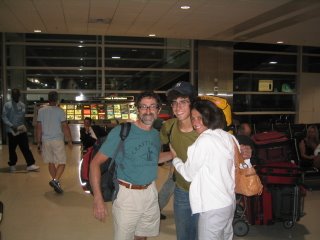
In the wake of Scotland Yard uncovering a massive terror plot to blow up planes over the Atlantic, Britsh Airways banned all types of carry-on luggage except the following items.
• Travel Documents
• Pocket-sized wallets
• Prescribed medicines
• Spectacles and sunglasses (without cases)
• Contact lenses, without bottles of solution
• Baby food, milk and sanitary items
• Keys, but not electrical key fobs)
If they included the following item on the list of acceptable items, I would have been much happier:
• Ian's laptop
After trying to find a loophole in the list that would allow me to take my computer on as carry-on luggage (laptops fall under the "other sanitary items" category, right?) , I realized that I would have to take the ultimate risk (in terms of traveling with a computer) — put it in my checked luggage.
Solution: Scour Ben Yehuda Street asking merchants if I can have some bubble wrap. They understood my problem (or just wanted to get me out of their stores as quick as possible because they knew I wasn't going to buy anything) and gave me ample bubble wrap.
So I covered my computer with three layers of bubble wrap, put it in my computer bag, stuffed my computer bag with newspaper and put the bag in my North Face duffle. Now I am typing this post on my computer, which means one of two things: either my packaging worked or my computer broke because of my shoddy packaging job and I got it fixed in time to write this entry (I will go with the former).


To compensate for the space that my computer and other normally carry-on items occupied in my duffle, I was forced to purchase another piece of luggage. While I wanted to purchase a shuk bag and use it as my primary backpack on campus this year, the top of the shuk bag cannot be sealed. So I bought an Israeli-made backpack instead (I am comforted by the fact that on the website for the company that makes my backback, they list ballistic body armor as their top product).
What did you actually bring on the plane?
Here is a picture of my bag an its contents. Since I was allowed to bring a Ziploc bag, I wanted to bring the biggest Ziploc back that I could find.

Aside from travel documents, the only other item in my bag were wet naps that my mom gave me when I left back in May and never used. Because the wipies were on the list of acceptable items, but only if you are traveling with small children, I wanted to see if they would let me bring the on the plane. The person working the counter at Ben Gurion warned me that they might not let me bring the wet naps on the plane from England, but security in London didn't have a problem with them.
Except for not having any carry-on luggage, my travel was uneventful. I made my Sherut at 3:50 on Sunday monring. Actually, I accidentally dozed off for a few seconds at the gate while waiting for my flight, but someone that I met while waiting in line to check my bags woke me up (After staying awake for 24 straight hours, I probably shouldn't have sat down at the gate with nothing to do 10 minutes before they started boarding). I went through security and made my connection in London without any problem. The person that sat next to me on the plane arrived at the airport at 7:00 a.m. on Saturday for a noon flight and didn't get through security in time. Luckily, I was only making a connection and didn't have to go through intense checks that other passengers had to (It makes you wonder what happens to all of the stuff that got confiscated at security because of the intense security measures. I believe that the workers have a lottery and use the draft format to select which items they want).
By the way, I was not bothered by the lack of carry-on luggage on British Airways becausee their in-flight entertainment is second to none. Every passenger has a personal TV with, either 18 different channels of movies and TV (I had this from Tel Aviv to London) or an On-Demand style setup where you can select from over sixty different movies, TV shows or music channels (I had this from London to Detroit).
And I finally arrived at home. My parent were very happy to see me. I was very lucky because the London-Detroit flight was the only US-bound flight that I saw was leaving London on Sunday morning.
Thursday, August 10, 2006
Hear ye, Hear ye
If you didn't know, I am leaving Israel on Sunday morning, which means that I'm trying to make the most of my final few days here (I have already consumed eight kilos worth of nectarines and plums this week). In the meantime, I am planning on writing a final recap post for my summer. Part of it will include a press conference, that's where you guys come in. Please send me questions, either through e=mail or the comments section, that you would like me to answer in this "comprehensive" review of the summer.
This post will also include some things that have happened in the last week (pretty busy -> no blog time). Expect this final post to be up sometime when I get back to America (I would've wanted to post it before I leave but I need to bubble wrap and put my computer in my checked luggage), I hope.
This post will also include some things that have happened in the last week (pretty busy -> no blog time). Expect this final post to be up sometime when I get back to America (I would've wanted to post it before I leave but I need to bubble wrap and put my computer in my checked luggage), I hope.
Saturday, August 05, 2006
I've been stomping in my Z1s
After almost three months of wearing my Chaco sandals every day, I think that it is about time to reveal to the blog community the development of my sandal tan (a photo was leaked via e-mail earlier this week). Throughout the summer, I have periodically taken pictures of my feet to track its progress. Instead of the traditional "Ian wriiting a blog entry with words," I have decided to go with the "a picture is worth a thousand words theory" for this post.
A few points before the pictures:
A few points before the pictures:
Almost everybody that has seen my sandel tan has marveled at its beauty and overall sweetness, except for the people that I spend the most time with (Ari and Peter are very anti-Ian's sandal tan [and Ari also opposed the blister that developed on my big toe for the first half of the summer before it healed])
If I was asked what body part am I most proud of, the answer, without more than a second's hesitation, would be my sandal tan (Call my superficial if you want).
In previous summers, I would try to mix a multi-level sock tan with the Chaco tan (I play a lot of golf at home) but there is something about the simplicity of the "Z" that makes this year's version that special (I am not allowed to wear sandals at the ballpark, so my tan has also been hampered by that in year's past).
Someday, I plan to write a song called Z1's to parody my favorite hip hop song of all time (You couldn't get this tan pattern if you had a personal genie).
I hope that this is what Michigan punter Zoltan Mesko's foot looks like.
Each of these photos was taken after I took a shower or woke up in the morning because I believe that the tan you exhibit when you return from being outside does not present an accurate pigment.
I have refused the urge to use pigment-enhancing substances (take that Alex Sanchez, Floyd Landis, Justin Gatlin, Tim Montgomery, Matt Lawton, Rafael Palmeiro, Bryan Berard and many more). 


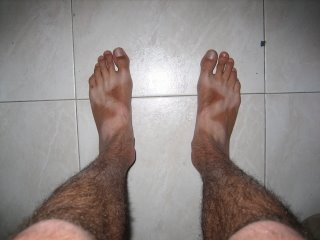
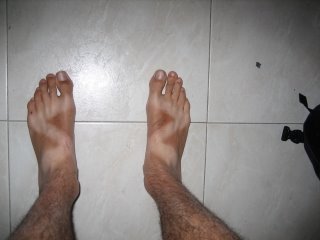


Friday, August 04, 2006
Tisha B'Av in Jerusalem: kind of a downer
Yesterday was Tisha B'Av, the saddest day on the Jewish calendar. Many of the saddest events in Jewish history occured on this day: the destruction of the first and second temples, the end of the Bar Kochma Revolt, the declaration of the Crusades in 1095, the expulsion of Jews from England in 1290 and the expulsion from Spain in 1492.
Tisha B'Av is the culmination of a three-week period of semi-mourning. On Tisha B'Av you fast for 24 hours (actually a little bit more than 24) and you don't bath or wear leather.
I kicked offf the day by visiting the Kotel on Wednesday night to hear Ekah (Lamentations), which is the book that you are supposed to read on Tisha B'Av. I expected the Kotel to be much busier than it was. We went to the Southern portion of the Western Wall for the egalitarian service. The reading of the Ekha put me in the right mood, but they sang songs at the end of the service that kind of ruined the somber mood (I always thought that you weren't really supposed to sing on Tisha B'Av).
Yesterday afternoon, I walked over to visit Avery (he also had the afternoon off). It is the last time that I will see him in Israel becuase he goes home on Sunday. We caught up and shmoozed for a while. He gave me a tour of the youth village that he stayed at.
After visiting Avery, I went to Har Herzl for the funeral of Michael Levine, a 21-year old American from Philadelphia who made Aliyah, joined the Paratrooper division of the Israeli Army and was killed in fighting in Lebanon earlier this week. Although I didn't know him personally, I felt like I did by the end of the funeral.


The Jerusalem Post gives a better recap of the funeral than I could. If you click on the link, you will notice that many people have left messages.
After the funeral, I had a little more than an hour before than end of the fast. I decided to walk home from the cemetery to pass the time. I broke fast with a mango, some bread, labene and olive oil.
Tisha B'Av is the culmination of a three-week period of semi-mourning. On Tisha B'Av you fast for 24 hours (actually a little bit more than 24) and you don't bath or wear leather.
I kicked offf the day by visiting the Kotel on Wednesday night to hear Ekah (Lamentations), which is the book that you are supposed to read on Tisha B'Av. I expected the Kotel to be much busier than it was. We went to the Southern portion of the Western Wall for the egalitarian service. The reading of the Ekha put me in the right mood, but they sang songs at the end of the service that kind of ruined the somber mood (I always thought that you weren't really supposed to sing on Tisha B'Av).
Yesterday afternoon, I walked over to visit Avery (he also had the afternoon off). It is the last time that I will see him in Israel becuase he goes home on Sunday. We caught up and shmoozed for a while. He gave me a tour of the youth village that he stayed at.
After visiting Avery, I went to Har Herzl for the funeral of Michael Levine, a 21-year old American from Philadelphia who made Aliyah, joined the Paratrooper division of the Israeli Army and was killed in fighting in Lebanon earlier this week. Although I didn't know him personally, I felt like I did by the end of the funeral.


The Jerusalem Post gives a better recap of the funeral than I could. If you click on the link, you will notice that many people have left messages.
"Today on Tisha Be'av here in Jerusalem, the place where our hearts have been breaking throughout Jewish history, they are breaking once again," Rabbi Allen Silverstein said Thursday, speaking to the hundreds of mourners who packed the Mount Herzl military cemetery Thursday evening to honor St-Sgt. Michael Levin.
Levin, 21, was one of three soldiers killed Tuesday in clashes with Hizbullah in the southern Lebanese village of Aita al-Shaab. An immigrant from the United States, he had been living in Israel for the last three years.
Silverstein, Levin's uncle, pointed out that his nephew was named for a relative who also fought bravely on behalf of his country, a decorated World War II veteran. Levin also had another link to the war, as his grandfather was a Holocaust survivor.
"We will all miss Michael," he said. "But we will continue to be inspired by his passion and his love of Israel."
That sentiment was reflected in the large crowd, mourners who endured a broiling sun despite fasting in honor of the holiday. Hundreds of American and Israeli friends, family from the United States and fellow soldiers from his paratroopers battalion came to pay Levin their final respects.
Among those present were his parents and two sisters, one older and one his twin, who arrived in Israel earlier on Thursday.
Those who knew Levin through the army praised his family. Tzviki Levi, who works with lone soldiers, said emotionally, "A Jewish family who lives on the other side of the sea, [whose son's life] ends as a soldier and a bearer of the red beret ... I will never, never forget you."
Another soldier, who was fighting alongside Levin at the time of his death, told his blood relatives that their unit will "always [be] Michael's family, and you are, forever, one of us."
As the sun began to fade, a second member of Levin's battalion ended his remarks with a final word to his fallen comrade: "In the end, all that is left is the light - the light that is as bright as the sun, and the happiness that you brought to everyone with its rays. All of this will stay in our hearts forever, and will help us to carry on. Thank you, Mike, for being who you were."
After the funeral, I had a little more than an hour before than end of the fast. I decided to walk home from the cemetery to pass the time. I broke fast with a mango, some bread, labene and olive oil.
Tuesday, August 01, 2006
And my third decade begins
Some of you knew that I had a birthday this week. Others of you just found out (It was on the 30th).
I'm not one to make a big deal about birthdays but, nonetheless, I wanted to tell you how I spent it.
As I recall, the birthday is a 24-hour affair, so we must start at midnight. At 12:00, I was sitting in a pub in Jerusalem with Peter watching CNN on one screen and Mars Attacks on another screen, while recalling our daytrips from earlier in the day (I went to Tel Aviv and Peter went to the Dead Sea).
At about 12:15, we left the bar and went our separate ways.
I woke up at about 8:00 to help build another bench at a community garden, this one was in the courtyard of a school for kids with special needs. I left there at about 12:30 to go to work. I slaved over the Penske File until about 5:30 (Arthur Penske thinks I'm Penske material).
After work, I met Ari, Peter and Hy in Kikar Zion to walk to a restuarant by my apartment called Al Dente. It was a very nice Italian Restaurant. I ordered the pumpkin ravioli and was satisfied.
No offense to Mars Attacks (and its all-star cast and Jack Nicholson puts in an Oscar-caliber performance), the delicious meal or the bench building, but I would have to say that I capped off my birthday in the best way possible, watching my first Tigers game since I left the US.
From the restaurant, we went to my apartment to pick up my computer so that we could watch the Tigers-Twins game on mlb.tv using the free wireless on Ben Yehuda Street.
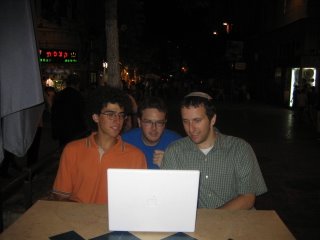
Win or lose, it was a special experience. We camped out on the benches in front of Moshiko Falafel and Shwarma (where you don't buy the falafel, the falafel buys you) and watched the game. Things looked great for the Tigers through seven+ innings. Brent Clevlen (I apologize but he doesn't have detroittigers.com profile yet) turned in a stellar debut, including a brilliant one-hopper from center to get Luis Castillo trying to tag home in the first that set the tone for the game. In the eighth, things didn't go so well for the Tigers, but I was too happy to be watching a Tigers game to have the result change my feelings Just a side note, the Tigers didn't lose their lead until 12:02 on July 31 (Coincidence. I think not).
By the end of the game, my computer's battery had run out, so we had to plug it in at Moshiko to watch the end of the game. Here I am paying for the electicity that I used.

If I would have been in Ann Arbor for my birthday, I would've gotten a free t-shirt, ice cream, car wash and dinner. In Jerusalem, I found no birthday discounts.
I'm not one to make a big deal about birthdays but, nonetheless, I wanted to tell you how I spent it.
As I recall, the birthday is a 24-hour affair, so we must start at midnight. At 12:00, I was sitting in a pub in Jerusalem with Peter watching CNN on one screen and Mars Attacks on another screen, while recalling our daytrips from earlier in the day (I went to Tel Aviv and Peter went to the Dead Sea).
At about 12:15, we left the bar and went our separate ways.
I woke up at about 8:00 to help build another bench at a community garden, this one was in the courtyard of a school for kids with special needs. I left there at about 12:30 to go to work. I slaved over the Penske File until about 5:30 (Arthur Penske thinks I'm Penske material).
After work, I met Ari, Peter and Hy in Kikar Zion to walk to a restuarant by my apartment called Al Dente. It was a very nice Italian Restaurant. I ordered the pumpkin ravioli and was satisfied.
No offense to Mars Attacks (and its all-star cast and Jack Nicholson puts in an Oscar-caliber performance), the delicious meal or the bench building, but I would have to say that I capped off my birthday in the best way possible, watching my first Tigers game since I left the US.
From the restaurant, we went to my apartment to pick up my computer so that we could watch the Tigers-Twins game on mlb.tv using the free wireless on Ben Yehuda Street.
Win or lose, it was a special experience. We camped out on the benches in front of Moshiko Falafel and Shwarma (where you don't buy the falafel, the falafel buys you) and watched the game. Things looked great for the Tigers through seven+ innings. Brent Clevlen (I apologize but he doesn't have detroittigers.com profile yet) turned in a stellar debut, including a brilliant one-hopper from center to get Luis Castillo trying to tag home in the first that set the tone for the game. In the eighth, things didn't go so well for the Tigers, but I was too happy to be watching a Tigers game to have the result change my feelings Just a side note, the Tigers didn't lose their lead until 12:02 on July 31 (Coincidence. I think not).
By the end of the game, my computer's battery had run out, so we had to plug it in at Moshiko to watch the end of the game. Here I am paying for the electicity that I used.

If I would have been in Ann Arbor for my birthday, I would've gotten a free t-shirt, ice cream, car wash and dinner. In Jerusalem, I found no birthday discounts.
Subscribe to:
Posts (Atom)
