Thursday, July 27, 2006

I thought single ply was out of style

I'm a messy eater. I'll admit it. In terms of the food on the fork to food that reaches the mouth ratio, I have one of the lowest numbers of people I know. It's no surprise that I rely heavily on the napkin and other absorbant paper goods when I eat.

Normally, I consider the napkin a standard request at restaurants. As in, if I buy a five-dollar sandwich, I feel entitled to as many napkins that I feel necessary, within reason, to ensure that the food stays off my clothes. Some restaurants even leave napkins out in the open so that people can take as many as the wish without disrupting the employees. Well, at least I'm used to those luxuries in napkin-rich America.

In Israel, it's a whole different story. Restaurants often provide few to no napkins, and the chances of a napkin dispenser are lower than Marty Morningweg's reputation as an NFL head coach (zing!). It's no wonder that I have ruined several pairs of pants and shorts with food stains that could've easily been avoided with ample napkin supply.


Even when they do give napkins, it's never more than two or three of the really light, single-ply (do I need a dash on single-ply?) paper ones that can handle about as much water as I can beer (zing again!). If I am eating a normal meal, no matter what I am actually eating, I require at least five to six of those.

A few anecdtoes:

I was eating lunch in the Central Bus Station food court a couple of weeks ago. While waiting for my food, the person ahead of me in line asked for a couple of napkins. The employee behind the counter took two napkins from a small pile that is well out of the reach of the customer. As he was about to hand them to the customer, he took one of the napkins away and only gave one napkin.

After I got my food, I realized that they didn't give me any napkins (no big surprise). So I decided to ask for a few napkins. The person behind the counter gives me two of those thin napkins that are best compared to doily. When I ask for a couple more napkins, the employee takes my request as a personal offense. He gave me one more.

(Hands on shoulders, let's take a 20-second timeout)

Does my 18 shekels for a sandwich not give me the right to as many napkins as I think that I require? Do I have to pay more to get a napkin? How did we become so frugal with napkins that we can't afford to provide customers with a satisfactory amount? Are the profit margins that slim that the company afford another box of napkins? Or am I crazy for having such radical ideas?

One of the best burger joints in town, Burger's Bar, is equally as frugal about napkins, which is weird coming from a restaurant that serves such napkin-intensive foods like burgers and fries. The napkins at Burger's Bar are all behind the counter, which means that you have to get the attention of an employee in order to get something to wipe that kethcup off you cheek with.

Last night I had my first Burger Ranch experience of the summer I'm not much of a fast food guy but I figured that it would be a shame to go through the summer in Israel, home of countless kosher fast food places, and not eat a burger at one of them. My "S" (I think it stood for "small") Meal inclluded a burger, small fries, medium pop and one single-ply napkin. (What the hell?)


At every meal that I eat, I find myself examining napkin availibility, which means that there is a clear napkin problem in this country. In fact, I have found myself doing exactly what the restaurant protect against: hording napkins when availible. When I eat a restaurant with a public napkin dispenser, I horde the napkins and put them in my bag so that I have them for future meals (What have I become?).

If you have any ideas on how to solve this problem, please let me know so that we can make Israel a more customer friendly (don't even get me started on customer service) to live and visit, one ply at a time.

Wednesday, July 26, 2006

I think it was the black and white cookie

This is a post that I never planned on writing, but things happen. If you're not into reading about throw up streaks, please don't continue.

(from The Dinner Party
JERRY: I feel like I'm going to throw up.

ELAINE: Hey, what about your vomit streak?

JERRY: I know, I haven't thrown up since June 29th, 1980. . . Fourteen years down the drain.

Now, I don't recall the last time that I threw up, which means it has been a long time (Right now, my best guess would be over 3300 days ago). The streak is not as long as Jerry's was, but I consider it impressive nonetheless.

Using my current estimate for the last time it happened, I have surpassed the Ironman himself by near 700 days. Cal Ripken played for 2632 straight games, but he got to take 200 days off per year. My stomach can't take days off. It has to go to work all the time.

Ironically, I mentioned my vomit streak in a conversation with a friend (it would be weird if it came up in coversation with a stranger) a few days ago. But I don't consider that a jinx because when the subject of vomit streaks arises, I don't hesitate to discuss my feat (I can get witnesses if you want).

So we start anew with the infamous day of July 25, 2006 (Should I add a "days since I last threw up" counter on the side of my blog? Probably not).

Oh yeah, I am feeling fine, no need to worry (I volunteered yesterday afternoon, worked at night [I took the morning off to allow my digestive system to reset] and went out after that). It must've been something that I ate (I can think of about five possible culprits that I ate in the 24 hours leading up to the moment that might have caused it).

Sunday, July 23, 2006

Coming up for air

Before I write this post, I want to give you an update on my security situation. While the northern part of Israel is under bombardment from Hezbollah rockets, life in the center of the country is continuing almost as normal. Aside from the eastern Negev, I would consider Jerusalem to be one of the safest places in the country right now. Besides paying more attention to the news than normally and not riding buses, my life is not much different than before.

Now on to the most massive post of the summer (hey, I have to recap two weeks)

The last week has been hectic to say the least. Follow this equation:

Current situation in the north + Ian's busy schedule + no internet in my room on Wednesday or Thursday = limited time for blogging

Another possible to that solution is that I have plenty to write about. So let's get started.

We last left off (aside from an expose on the shuk bag phenomena) with the first meeting of the exotic fruit tasting society, which means that more than a week has passed since I updated you on what I am doing.

Let me take you back in time nearly two weeks to the Israel Track and Field Championships, which I covered for the Post. These were two exciting nights at Hadar Yosef Stadium in Tel Aviv. I wrote two articles for the paper. If you click on these links, you will find evidence of my work here, here and not here. Having covered the Michigan track team for two years, you get spoiled with following world-class athletes on a regular basis. In Israel, there are two track and field athletes that are competitive on an international level. So, it's a change of pace (literally).

A week from Thursday, I volunteered with the maintenance staff at Alyn Hospital again (Did I even mention the first time?). This time I painted the door to the generator room. Here is my mindset: I am happy to paint the door because people who would paint it otherwise have more important things to do and can't be bothered with this type of minutia.

The next day, Avery arrived for his weekend off. He took a cab from the youth village to my apartment to drop off his bags. We picked up another cab and went to go see Pirates of the Caribbean (for those that remember an earlier post of mine, I ranked this as one of the most highly anticipated movies of the summer). I don't think it lived up to the hype, but then again, how many sequels aside from D2 actually do?

After the movie, which was in the industrial neighborhood of Talpiyot on the other side of town from my apartment, I decided that a pleasant stroll through the city would give us the forum to shmooze for a while and allow Avery to see the city. After the trek, I took him to the four shekel falafel place before we went to the shuk.


For those that don't know, Avery is an expert when it comes to the kitchen. He knows his way around the kitchen almost as well as my dad knows his way around Detroit, which made this excursion to the shuk one of the most highly anticipated shuk visits of the summer (There were posters up and down Agrippas announcing Avery's arrival right next to the Shneersin Messiah posters). Avery was in heaven and the only way that he could have had a better time in the shuk would've been if there wasn't a language barrier. Nonetheless, let me recap what we purchased:

Half watermelon, three kilos red grapes, mangos, dried apricots, prickly pineapple, little pear, hummus, labane, pita, and probably something else (hey, it's been two weeks). This was also the site of Ian taking pictures for the shuk bag feature.

After the shuk, we went to Shabbat services at Shirah Chaddashah, a cutting-edge orthodox synagogue in the German Colony. We followed that up with the Shabbat dinner with some friends at their hotel (thank you very much, once again). Avery and I both reached the state of food coma.

We went back to my apartment after dinner and convened the second meeting of the exotic fruit tasting society. Ian and Ari tasted dragon fruit, little pear, and prickly pineapple. In conclusion. the prickly pineapple is the best pineapple we have every eaten. The other two weren't so great. Sorry about the lack of pictures from this event, we didn't want to ruin the spirit of Shabbat. After the dessert tasting, we went to a tish in Mea Sha'arim, which is one of the most interesting things you will every see. Sorry about the lack of pictures, I didn't want to lose my life by snapping a closeup of the rebbe.

On Saturday, we slept in until 12:15. I guess we needed the sleep or something. For lunch, we went to some other friends' hotel (thank you very much) and again achieved the state of food coma. In the afternoon, we went for a walk to the kotel.

On Saturday night, we went to get some good hummus, saw the satire Thank You for Smoking at the last night of the Jerusalem Film Festival and went to the Marakiah (a soup restaurant that doubles as a bar). We (Ian, Ari and Peter) had been searching for this ever-elusive establishment for a couple weeks, which made finding it that much sweeter. (Let's just say that since that first night, we have been back there twice and plan to go again tonight)


Avery went back to his group on Sunday morning. On Sunday night, I covered another

On Tuesday my friend Hy, who staffed the Detroit Teen Mission before it ended prematurely becuase of the current situation, spent the night on my floor. Hy is better known at the former bat boy for Groves High School baseball and one of the most talented cowbell musicians in the world. After I volunteered at Alyn again, we went out to dinner with Erick and his family (thank you very much).

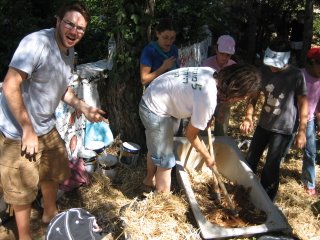
Wedenday morning, Hy and I volunteered at one of the community gardens that I have been working at all summer long. We worked with a group of 40 kids from a neighborhood day camp to make a bench out of rubber tires and mud. Despite Hy's aversion to getting dirty, we had a great time (except when the kids decided to throw stones at Hy).


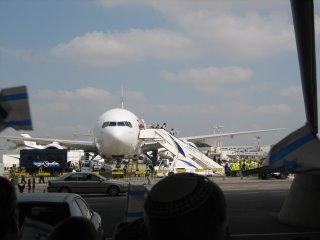
On Thursday, I woke up early to catch a bus to Ben Gurion Airport to welcome a Nefesh b'Nefesh flight of Americans making Aliyah. I was supposed to meet the bus at 6:45, but some alarm issues arose and I didn't get out of bed until 6:55. I sprinted to the entrance to the city and caught the bus before it got on the highway.

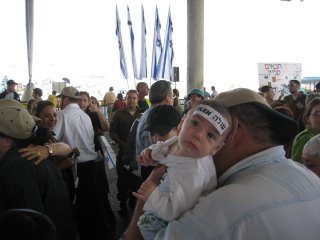
The welcoming ceremony was under a canopy in the middle of the runway at Ben Gurion. After the passengers deplaned, they came to the site of the ceremony where they hugged and kissed family who came to meet them. It was a very emotional experience, especailly considered the current situation. Bibi Netanyahu addressed the new Olim and stressed the importance of Aliyah.


That night, I went to dinner at Luigi's with the rest of the Jewish Academy (my high school) contingent in Israel. The food was good, the company was even better (which says a lot considereing the quality of the food).


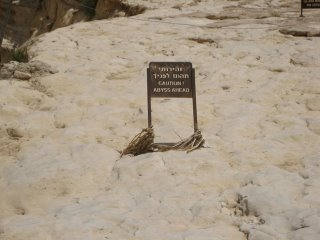
It wasn't that late of a night, though. I had to catch a 7:15 bus to the south, where I spent shabbat. We did a brief tiyyul at Ein Ovdat (next to Sde Boker [site of David Ben Gurion's grave and house]). Check out this sweet sign on the trail.


Afterwards, we went to Beer Sheva for lunch and to hear a speaker talk to use about how Ethiopian Jews maintian aspects of their culture, instead of completely adopting Israeli culture.

For Shabbat, we stayed a hostel in Yerucham, a development town directly in the middle of nowhere (it's about 15 minutes from Dimona and 40 from Beer Sheva). Yerucham is known as one of the poorer devleopment towns in Israel and has a very large immigrant population. On Saturday afternoon, we went for a walk around the town in which our tour guide explained to us different strategies the city has employed to vitalize. (A brief aside: The Shabbat food was not very spectacular, maybe even worse than Fayetteville, Ark where they had trouble comprehending the term "vegetarian")

On Saturday night, we got back to Jerusalem at about 11:30. I went to Zion Square to drink tea and people watch with Peter.

Yesterday, I had a track meet to cover in Tel Aviv. After the meet, I went out with Peter and Erick (who went home this morning) to a really cool bar called D1. It was as if the owners just took an abadnoned building, threw in chairs, tables, a bar, and some record covers on the wall. Erick taught me and Peter how to play Shesh Besh (backgammon).


Boy, this post turned boring for the final five or six days. I promise to blog more often. By now, I just want to use this post as a reference to remember what I did during these last two weeks. In the next week, I promise a post about movies that I have seen, an explanation about what I do at work and another expose about a troubling part of Israeli society.

Saturday, July 15, 2006

The latest in open-air market fashion

Some things never go out of style in Israel.

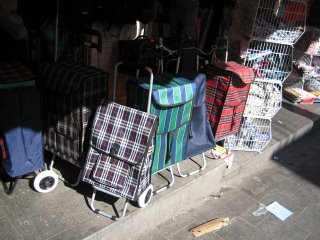
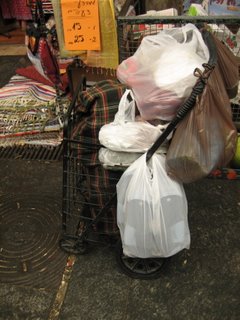
Black tefillin, wrinkled white shirts, black hats, obscene English t-shirts, talking politics, and..... plaid shuk carts?

If there is one staple in Israeli society it is the Al Borland-style bag to wheel around your shuk purchases.


Every time you enter that wonderland of Mahane Yehuda, you are greeted by a few things; the smells of the spices, the shopkeepers yelling out their best deals, the stench of dead fish (no it's freedom, no it's fish), and the customers walking through the crowded alleys dragging around a plaid-patterned cart.

Let's be honest. None of the shuk bag patterns actually look good. They are hideous. If a fashion designer really wanted to hit it big in Israel, he or she woluld open up a designer shuk bag outlet at shuk prices to compete against this guy.


I guess that the shuk bag is a once-in-a-lifetime purchase, along the lines of a stroimel or sabra fruit. But the funny thing is that there are only about six different patterns for shuk bag that you see in the market. They are also the only ones that they sell in the outlet store (it's located near the Agrippas entrace on the main drag).

It also raises the question of how the plaid Shuk bag took off like Beanie Babies a few years back but has the staying power of Corn Flakes.

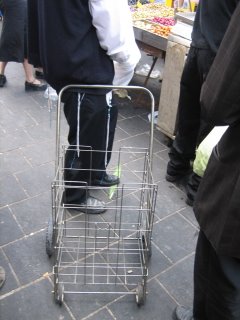
In our investigation, we did discover that some people have boycotted patters all together, preferring to go with the cage instead. But, let's remember that things fall out of holes, no matter what size. If someone's liche falls out of their cage bag, I can't be held responsible.


Check out this person. They are trying to think outside the box by thinking inside the cage. Bottom line: There is still plaid.


That is why we are proposing that a revolution in Shuk fashion. What about striped? Spotted? Plain-color? Berbery? Famous paintings? Pictures of shuk bags on shuk bags? Anything but plaid.

Viva la revolucion.

Monday, July 10, 2006

Where the wild fruits are sold

Before watching the World Cup last night, Ari and I decided to explore Mahane Yehuda (the shuk down the street). Since we both live a stone's throw (rather, a drive and chip shot) away from there, we have an understanding of the physical geography of the shuk. I wouldn't say that I know the area like the back of my hand, but I still know it very well.

So what is there to explore?

As well as we know the shuk with our sense of direction, our taste buds are often lost. Whenever we walk through the shuk there is a type of fruit or vegetable that I pass that I think to myself "I have never seen that before" or "I walk by that everyday, I wonder how it tastes." Last night, Ari and I took a walk on the wild side.

The one rule: If you have never eaten it before, you need to buy it.

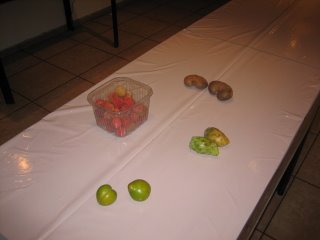
It was getting late, so the selection was not as impressive as it would have been earlier in the day but there is nothing we could do. We scoured the area and found four types of fruit that neither of us were very familiar with (frutis only, vegetables maybe for a different day).

The four species included: Liche, green plum, sabra (or cactus), and kiwi on steroids.


We walked back to Ari's yeshiva, washed them, said the shehechiyanu (the prayer you say when you eat a fruit for the first time), and gave our taste buds a chance to experience something new.

After extensive tasting, Ian and Ari came to the same conclsuions.

1. Kiwi on steroids

Per Ari's recommendation, I now believe that kiwi is not meant to be peeled. The fruit was so big and so delicious. There was an explosion of flavor with every bite (almost like the Shmooze cholent in the Iron Blech competion, except this one fnished first). It took me forty minutes to finish half of it, just because I wanted to savor the flavor.


2. Liches

On the outside, it looks like a spiky, painful fruit. On the inside, it is a soft, juicy, lovable fruit with a hard pit in the center. Just proving that you can judge a fruit by its shell or a book by its cover. Overall a positive experience, and I can see myself buying a crate of them in the future.


3. Green plums

Because of my experience with plums in the past, this fruit was handicapped from the start. But because I had never eaten a green plum before, it qualified for the competition. If I had never eaten a plum before in my life (what a shanda that would be), the plum would be near the top of this list.


4. Sabra

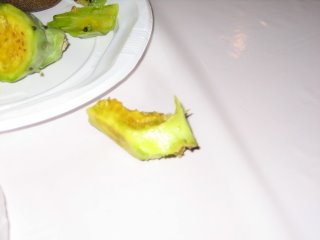
This prickly pear cactus tastes like a combination of honeydew and cucumber. But it is the effort that it requires to get to the inside that led to this fruit's demise in the competition. Ari complained all night long about pricks getting in his hand. The proper way to handle this in the future would be to peel the fruit with a knife and hold it with either gloves or a plastic bag. Or you can be a soldier and tough it out.


The game!! The Game!! Ian, I think he said "that's game."

For the first time since the 1994 World Cup (Brazil won at the Rose Bowl), the champion was decided by penalty kicks. I watched, along with more than a billion other people at the Italians, who are in the midst of a massive match fixing scandal that could ruin the credibility of the domestic league, defeated a the French, who nobody seriously wanted to win.

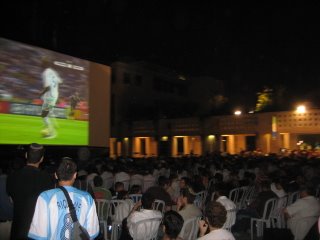
I went to Safra Square (City Hall in Jerusalem) where they set up a massive projection screen, and hundreds of people turned out to watch. There are four flag poles at the entrance to the massive square. Last night, an Israeli, Italian, French, and Jerusalem flag waved in the air (bad light = no picture of it).


(Look, I found another Ari)

If someone insults you in the 115th minute of the last game of your international career, which also happens to the be the World Cup final, what do you do? (I can really only think of two ways to react in that scenario)

a) Play on as if nothing happened because the result is more important than your pride for those few seconds.
b) Run a few steps in front of the player that insulted you so that you can get a running start to headbutt him in the chest.

If you are Zinidine Zidane, you would choose the latter. If you are the rest of humanity, the former.

I don't know if H. Jose, my co-worker at the Daily wrote his column before the game about how there is no limit to the stupidity of professional atheltes, but this would be another perfect example.

Sunday, July 09, 2006

Great Lake, Great Times

After a last-minute change of plans, I went to the Kinneret (Sea of Gallilee) this weekend (In Israel, weekend= Friday and Saturday). Unlike my other outings which were heavy on sight-seeeing, this adventure was more about talking to people and vacationing.

Aside from simply being a lake, which is not so common in the Middle East, and its historical significance, the region holds a special place in my heaert. After the War of Independence, my Papa Jules, who fought in the Hagannah, lived at Kibbutz Ein Gev, on the shores of the Kinneret, for two years before moving back to America. Since he died last year, I wanted to see if anybody at the Kibbutz remembered him or if there were any records of his time there.


After taking the bus to Tiberias and another one to Ein Gev, I arrived there around noon. I went to the main office to see if someone there could direct me where to go. Luckily, two people were having a meeting and they told me that one person still lived on the Kibbutz that has lived there since 1941.

I went to this man's hut and was greeted by his wife. I told her the story of why I came to Ein Gev, and she told me to have a seat and offered me some fruit. Her husband came home a few minutes later, and I explained to him my story. He did not remember anybody by the name of my grandfather (I guess in 60 years of living in Kibbutz where volunteers come and go, it is difficult to remember everyone).

Although he didn't remember my papa, the man and his wife were happy to talk to me about a whole array of subjects. They wanted to know where I was spending the night. When I told them that I didn't have any plans, they made some calls to see if there was space at the Kibbutz for me to stay. Unfortunately, the hostel and volunteer lodging were full. After that, the man took me to the cafeteria and gave me lunch, which was pretty good and more than I'm used to eating.

After lunch, I went back to the road to wait for the bus, which came about 20 minutes later. I decided that I would spend Shabbat in Tiberias, which is a city that I have never really visited. In fact, until Friday afternoon, I had never been in the Kinneret (On my high school trip, we did a disco boat but is more on the Kinneret than in it). My guidebook said that there were plenty of hostels in the area, so it wasn't a problem to make plans on the fly like this.

On the bus to Tiberias, I sat next to a soldier that I met while sitting at the bus stop. She came to Ein Gev with two other friends to spend their day off from the army. Did you know that Israeli soldiers in uniform can ride every bus in Israel for free, except for the ones going to Eilat?

The soldier that I sat next to works in the office of a mechanic shop for tanks. She finishes her army service in a few months and is planning on taking a trip like most other Israelis after the army.

Once I got to Tiberias, the first thing that I needed to do was find a place to spend the night. I found a hostel on Ha-shiloach St. a few blocks from the beach that offered a bed for 40 shekels for the night (less than 10 bucks/night). It passed the Ian test for whether he can sleep there (Does it have a bed and a toilet? [Actually, the toilet is not always required]).


I had three roommates. Two were from Holland taking a holiday from work for three weeks to travel around Israel. The othe was a Washingtonian who has spent the last two years traveling around Africa and Middle East. All three were very cool and had interesting stories (especially the American).

After getting my bearings set, I headed down to the beach to take my traditional pre-Shabbat dip/shvitz. Most beaches in Tiberias are not free, as in it will cost you a few sheks to bake in the sun. Luckily, I found the one free beach near the downtown.


While I was sitting in the water, I met a nice couple from Netanya who was up in Tiberias for the weekend. They are currently between their after the army trip and beginning university. In the meantime, the woman is working in customer service for the cable company, and I didn't find out what the boyfriend did.

After the beach, I went back to the room and got ready for shul. I went to the Sephardic shul next to the Sheraton on the promenade. For those that don't know, Sephardic Jews are Jews who trace their ancestry to the Jews of Spain. After the Inquisition, they were scattered throughout North Africa and Southern Europe. Some of their traditions and rituals are slightly different from Ashkenazic Jews (Central and Eastern Europe). It was the first time that I had ever been to a shul that recites the Song of Songs between Mincha (afternoon service) and Kabbalat Shabbat (welcoming of Shabbat service). I really enjoyed it.

After services, I told someone there that I didn't have anywhere to eat and asked if there is anybody at this shul that accepts guests for dinner. He said that I would have better luck at the Karlin Synagogue next door.

A man named Yossi, who is an elementary school teacher, welcomed me into his house for dinner. It was a long walk from the shul to his house (probably about a kilometer or about .62 miles). The walk was pleasant and pretty quiet. It was interesting though that we walked at such a slow pace. There was a group of religious Jews walking about 50 meters ahead of us. And, if that group stopped to chat, Yossi would slow down to a snail's pace as not to get closer. It also seemed that we were walking on side streets, while they would walk on the main road. Maybe it was just a coincidence, maybe it wasn't. (At times, we were walking at such a pace that I worked on my mozie, but it's just not the same without six-shooters at my side)

Dinner was delicious and the company was great. Yossi lives with his family of five kids under the age of nine (another is on the way) in an apartment. His mother-in-law was also there. Since everybody in Israel also learns English in school, the kids were excited to have a native English speaker at the house who they could talk to and show off their English with.

Yossi had never been to Detroit before, but he did mention that a famous Hassidic rabbi is buried there. He sadi that every year thousands of Hassidic Jews come to the rabbi's grave. I told him that the neighborhood that the rabbi is buried in is the most Jewish of places and that it is interesting to see all of these Hassidic Jews descend on this town.

After dinner, I went back to the hostel before heading out for a stroll (some witnesses reported a sashay) of the promenade. It was the busiest that I have ever seen and Israeli city on a Friday night. There were street vendors and music playing. I found the Dutch guys who were staying in my room at a bar on the waterfront and decided to hang out with them for a while. Afterwards, I continued my tour of the Tiberias Friday night life and met some kids from Herzaliya who just graduated high school. They are waiting to go into the army and came up to Tiberias for the weekend. After hanging out with them for a bit, I decided to call it a night.

In the morning, I slept in a little bit (Hey, I'm on vacation).


After I woke up, I headed to Mt. Arbel, which is a few kilos from town to do some hiking. I took a cab there and was banking on hitching a ride with some fellow hikers that I found at the trail. Because the place is so isolated from the main road, there is one road to take back and it goes to the main highway to town. I hiked around and met an Israeli couple who had just finished the army. There had slept on the eastern shore of the Kinneret the night before and were doing some hiking before returning to Tel Aviv. The're getting ready to go on a trip to New Zealand.


They offered to give me a ride back to the highway, and I walked into town from there.

I went back my hostel and met a group of law students from York University who are doing a program where they stay at Hebrew University in Jerusalem and study Israeli law. I went to lunch with one of them and the Washingtonian who slept in my room. We ate at Big Ben's restaurant on the promenade.

Their menu could have been one of the most unintentionally funny things that I have ever read. Here is the best example.
House Salad- It's full of goodies.
Big Ben (I think it was sandwich, but it didn't say)- It's big and full of goodies.

It doesn't say what's in the salad, just that there are good things. The Hebrew didn't help either, because it said the same thing. I decided not to order the house salad or the Big Ben.

We sat at the table for a couple of hours and just shmoozed (read: heard incredible stories from this guy's trip through Africa). After lunch, I decided to head down to the beach. I read my book for a few minutes, worked on balancing out my gardener's tan, and jumped in the water. It was not as busy as it was on Friday afternoon. Luckily, I went back to the free beach next to the old city wall.

As the sun was starting to go behind the hills of the Galillee, I went back to the hostel and saw that the people from York were leaving. They said that there was a 5:30 bus to Jerusalem (I didn't know tha the bus company operated on Shabbat). So, I couldn't pass up the opportunity to ride on a bus on Shabbat in Israel, plus I don't know what I would have done in Tiberias if I would've stayed. So, here I am getting on the bus.


A few quick hits from my trip:

Every shop in this strip sells falafel. That is eight stores. Since it was Friday afternoon, some were already closed so I couldn't do an effective price comparison.


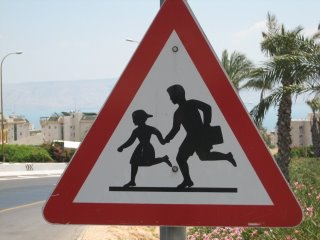
Caution! Parents chasing after children.

Wednesday, July 05, 2006

Hey cabbie! Quit killing yourself, myself, and my faith in society!

As I got in a cab today after work at a garden, I noticed a sign in front of my seat that said "please don't smoke." That's normal.

In the front seat, I noticed that the driver with an ignited cigarette in between his lips. Also a normal occurence.

After spending a month and a half in Israel, you start to get used to the fact that people of all ages smoke all the time, but given his sign that requests that passengers not smoke, I thought it would be appropriate if the driver would follow his own rule.

If I did smoke, I would light one up in the back seat and see if he noticed. Actually, what I would have done was ask him if he had a light. But, since I don't smoke, there was one possible solution to this situation, requesting that he extinguish his cigarette.

After I voice my request, he tries to explain to me how the open windows in the front seat mean that none of the smoke, or carcinogens from his cigarette found their way into my lungs. However, the smell of the car didn't support his claim. I insist that he put out his cigarette, which he tosses out the window. There was a cold silence the rest of the ride (Was is something I said?).

Now, I could have asked him to put out his cigarette simply because I didn't want the the smoke getting into my lungs (That was part of it). Now, I could have told him to put out his cigarette simply becuase he is killing himself (That was part of it, too). But mostly, I did it because of the hypocrisy of the situation.

What will cause more damage to me in the long run? The smoke. What will ruin my faith in society and make me wonder why there are rules at all? The hypocrisy of the situation.

If I could take a line from Mitch Weaver in Bob Saget's classic film Dirty Work (slightly differennt context but the message is clear):

Do you know what hurts the most? It's the lack of respect. That's what hurts the most. Actually, it hurts the most. It's the lack of respect that hurts the second most.

Tuesday, July 04, 2006

Thiry Years Since Entebbe

As some of you might know, yesterday marked the 30th anniversary Operation Yonaton, the IDF raid of the Entebbe airport in Uganda to free more than 100 hostages. Thinking about how little preparation that soldiers had for this mission (just over two days of planning and one day of exercises) and how successful the mission was (pre-mission estimates were about 20 casualties, according to my book) makes you realize how impressive the event actually was.

One must also think about how great of a risk Israel took by sending in this unit. Not only was Israel sending a group of soldiers thousands of miles away into the heart of Africa in a hostile country, but Israel was sending its best group of soldiers. If this mission did not succeed, it wouldn't only be seen as a military failure. It could have demoralized the entire country, forced the current government to resign, and put the country into a position that it might never have recovered from.

Despite the tremendous success of freeing the hostages, the mission is also famous because the commander of Israel's most elite group of soldiers, Yoni Netanyahu, was killed in the raid. But he was more than just an elite soldier.

In fact, I just finished reading Iddo Netanyahu's (Yoni's brother, also brother of Benjamin Netanyahu) book Yoni's Last Battle, which documents the planning and execution of the mission. Iddo had access to IDF records and interviews with the participants that paint a clear picture of exactly what happended before and during the operation.

In addition to finishing Iddo's book, I have also read Yoni's letters, which portray him as someone who had a passion for Israel, life, family, and knowledge. He was truly a unique individual. On my senior class trip to Israel, I chose his diaries as a book that would I bring because I felt that it would help give me a deeper connection to the land.

Being named Yoni, I feel a connection to Yoni and am proud to share a name with him. He is also on my list of people that I admire the most.

Sunday, July 02, 2006

Define "wrinkle-free"

For those that are unaware, this weekend was the opening weekend for the Yavneh Olami Summer Internship Program. After an opening barbecue in Thursday night, we headed up to the Golan Heights to spend Shabbat meeting people other people on the program and making strong first impressions.

One thing that didn't strengthen my ability to make first impressions, my shirt, particularly the unnecessary amount of wrinkles in my wrinkle-free shirt.

After a weekend of shlubby appearance, I would like the people at Van Heusen to explain to me what they mean when they advertise their clothing as "wrinkle-free." Three years ago, I bought a white shirt from this company under the impression that I could fold it in any direction, crumple it up as much I want, and roll it into a ball to fit it in my backpack, and the shirt would look like it just came from the cleaners.

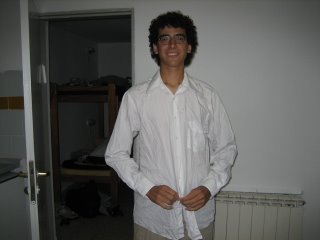
Au contrare. Take a look at what I was forced to wear this Shabbat.


It's not like I didn't recognize there was a problem. When I pulled the shirt out of my backpack after arriving at my Shabbat destination, I asked everyone I could if they knew any secrets to unwrinkling white shirts.

One person told me that steam takes the wrinkles out of clothing. So, I turned the shower on as hot as it could go, closed the door to the bathroom, and put the shirt on a hanger. I also decided to stand in the make-shift steam shvitz as my shirt unwrinkled (As you might know, I can't end a week without going to the shvitz or, when I'm in Israel, springs are also acceptble). I stood in there with my shirt for 20 minutes to monitor its progress. Let me just say that there was little progress to monitor, aside from the accumulation of sweat beads on my body. Here is a photo of my shirt after it was in the steam room for 20 minutes.


Do you notice any difference? Neither do I. Actually, I think that the wrinkle over the pocket looks worse after I steamed it.

Lessons I learned: Shirts might be wrinkle-free but once they become over saturated with wrinkles, they become creased. And no shirt is crease-free (that gives me a new idea for shirt technology, if only I was a fashion engineer).

Ironically, I took 30 minutes out of getting to meet people on Thursday night to go back to my apartment to pick up a belt to avoid looking like a shlub this weekend. Hey, at least I was wearing a belt with a wrinkled shirt, which is better than wearing a wrinkled shirt without a belt.

Do you know. . . .?

As you might expect, the opening weekend of the Yavneh Olami program turned into a massive game of Jewish Geography. Anytime you bring together 120 American Jews, the phrase "oh, you go to _____ University, do you know _____" is bound to make an appearance.

At one point, some of my friends started to create a scoring system for Jewish Geography but because we couldn't write it down (Shabbat), we didn't put it on paper or figure out the logistics. Before this weekend, I didn't know that the community of religious American Jews between the ages of 18-24 was so well connected.

Dropping names of people who went to yeshiva, seminary, and universities in New York City, I was able to establish a link with more than half of the kids on the program. And from these connections, strong friendships might develop over the summer, and more importantly, more names for future games of Jewish Geography.

Watersmeet in the Golan

Keeping in line with other travelogues and to help me remember what I did in Israel, I will go through a summary of my weekend from a more logistic point of view.

On Thursday afternoon, I took a cab to Bayit Va'gan (a neighborhood in Jerusalem that is not in walking distance of my house) to attend the orientation for the Yavneh Olami program. After saying that he knew where Yeshiva University in Israel campus was located, my cab driver revealed to me (through his actions) that he had no idea.

Just a note: for lunch I bought a loaf of bread and a container of hummus.

Since I am not living at the YU dorms, I hung around the main building at the campus until the orientation began. After the welcoming speeches and ice breakers, we had a cook out on the lawn (considering the landscape, you don't really have to say more than "the lawn" for people to know what you're talking about).

I spent the night on the floor in Ari's apartment (I hear that sleeping on that type of surface is good for your back) because the bus was leaving at 7:45 S.G.T. (Standard Group Time [for official departure, add 45 minutes]).


We drove north to the Golan Heights and visited some places of interest in the area. First, we went to Nimrod's Fortress (You remember the Watersmeet Nimrods from ESPN fame or Nimrod from the Bible, I don't know which one came first). We ate lunch of hummus and pita at the same picnic tables that Nimrod would eat hummus and pita, I think. Well, maybe not.


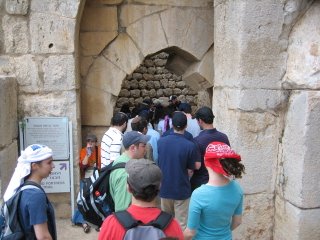
After lunch, we toured the ruins of the fortress, which was not actually around in the time of Nimrod. It was a crusader era fortress that does not have any of the marks of a crusader fortress. Most notable event from the tour: instead of calling it a bathroom or water closet, the parks service calls the medeival can (or as like to call it, hole in the ground) a convenience chamber.


After Nimrod's Fortress, we walked around the Banias. Did you know that the name Banias derives from the fact that there used to be a temple to the god Pan on that sight?

Air Conditioning? Who knew?

For Shabbat, we stayed at the guest house at Keshet, a moshav in the Golan Heights. For the first time in six weeks, I slept in a room that had air conditioning. Air conditioning in bedrooms = genius idea.

We held services in the guest house's bomb shelter. Things that I can now check off my list of stuff I hope I don't ever have to do again: I exitted a bomb shelter through a emergency exit.

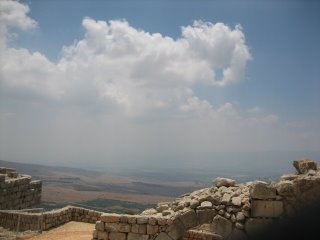
On Saturday afternoon, we walked up a hill that looked down on the moshav and much of the Golan. Our tour guide told us the history of the settlement (how it is undergoing a major privatization) and pointed out sights of interest on the horizon (Mt. Hermon and the lack of snow on top, the Kinneret [Sea of Galillee], wind power plants, and the Syrian border). If you can't tell from the photos from Nimrod's Fortress, the Golan is a beautiful area.

Tuesday, June 27, 2006

Well Helllloooooooooooo, Laaa Laaaa Laaaaa

First off, I would like to welcome my younger brother (as you can tell from the photo, I can't use the word little brother anymore), Avery, to Israel. He will be here for five-six weeks on the Ramah Seminar program. He arrived in Israel early Tuesday morning after spending a week in Poland. I met him at the Kotel later that night. (Note: there is very little hair under that hat. And if you can't tell, he has a Detroit Tiger's hat on [My Tigers!]) He brought me a portion of a once-large salami and I brought him some fruit and rugelah.


For the past few years, my parents have participated in the Wheels of Love bike ride to support the Alyn Pediatric and Adolescent Rehabilitation Center and Hospital in Jerusalem. Monday morning, I went on a tour of the hospital to see what my parents have been riding for. Let me tell you that I was amazed.

They welcomed me with this big sign. However, I entered through a different door and didn't see the sign when I walked in. But my tour guide showed it to me, and I posed for this photo op.


The things that do with the kids are incredible. The hospital believes that every person should be given the chance to achieve their full potential, no matter what challenges they must overcome. Through countless forms of therapy (Physical, speech, animal, humor, music, swimming, etc.) and mixing education with rehab, the hospital staff does this. Some of the stories that my tour guide told me are amazing. Because there are some many inspirational things that I heard and witnessed, let me highlight the one that I found to be the most.

At the beginning of the tour, we walked through the educational wing and popped into some of the classrooms. In the auditorium, there was a group of kids on the stage rehearsing for a production of an Israeli play. Since all of the kids have unique restrictions, the staff finds ways for them to participate in the performance. The quadrapelic children used a device that allowed them to make sounds by pushing a button with thier chins. They were all wearing costumes too, which were draped over wheelchairs and crutches, and were also very cute. No matter how much a kid was limited by their disability, the musical therapist found a role for them in the production.

I was so enamored with Alyn after my tour that I decided I wanted to spend time volunteering there. Here I am putting together rider packets for next year's ride.


Some of the blog readers will get these packets in the mail, assuming I put them together correctly. In the future, I plan on working with the maintenance staff doing whatever they need me to do.

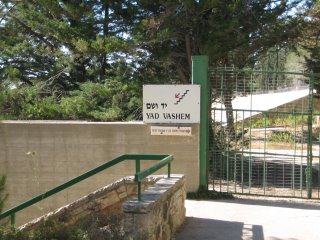
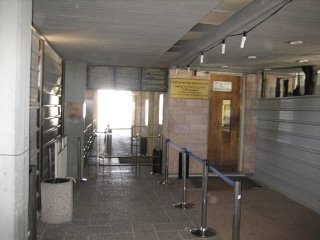
After my tour, I went to see the new Yad Vashem Holocaust museum. It was an impressive exhibit. I spent four+ hours trying to read and take in as much as I could, but I still feel like there was stuff that I didn't get to. I think that how they incorporate the individual testimonies within the greater exhibit adds a unique dimension. Even after touring the new wing, I still think that one of the most powerful parts of the museum is the memorial to the children.


After I finished touring the museum, I went to the cloakroom to pick up my back pack and ran into my high school Hebrew teacher, who was at Yad Vashem as part of a conference for educators and was eating in the cafeteria. Interestingly enough, it was in her class that I read Night by Elie Weisel and Dan Pagis's poem Written With a Pencil in a Sealed Cattle Car. It was great to see her, and she was very impressed with my Hebrew.

I also found time this week to sit in on a session of Knesset, Israel's parliament. I have spoken to some rather fluent Hebrew speakers who said that they couldn't understand what the ministers were talking about when they went, so I didn't go in with high expectations.

Here is what I got out of my 20 minutes watching from the public viewing area that faces the front of the room:
• They mentioned the prime minister several times.
• They mentioned the Gush Katif settlers and statistics about how they have fared since the pullout.
• I need to improve my Hebrew if I ever what to consider becoming an Israeli politician.

Noteworthy from my experiece walking through security: It was the first time in my life that I was simply called Jacob. For those that are not aware, Jacob is my middle name but nobody has every called me it. Each Knesset visitor must present their passport to the security desk, which gives you a sticker with your name and purpose. My sticker read: Robinson, Ian Jacob (except it was right to left and in Hebrew). Two theories about why he called me Jacob: He didn't know how to pronounce "Ian" transliterated to Hebrew or Jacob was the last name on the line so that was easiest. I will go with the latter.


Did you know that you are not allowed to bring books into Knesset? I walked through and forgot that my book was in my pocket. The security guard reminded me and told me to put it in the "cloakroom."

Sunday, June 25, 2006

Searching for the mystic in me, among other things

It took three trips to Israel, but I finally visited Tsfat (the hub of mystical Judaism) this weekend (There are numerous acceptable and unacceptable English spellings of the city's name). I had no idea what I was missing.

Actually, I was supposed to be in Safed for the first Shabbat of my senior class trip but weather in New York delayed our flight one day and forced us to switch our plans.

Beware, flying stromels!

I met Ari (of watermelon-eating fame) at the Central Bus Station at 9:20 to take the 9:30 bus to Safed. But the website did not say that the bus loaded on the street across from the bus station instead of the terminals inside (or at least I don't think the site said anything). To make a short story even more consise, we missed the 9:30 bus and found space on the 10:00 one.

I chose my words carefully because by the time we boarded the bus, every seat was filled. So, we sat in the aisle. Ari and I shmoozed for an hour before he drifted back to sleep for some time. He was unexpectedly awaken from his slumber by stroimels that fell from the overhead storage space when the bus made a sharp turn.


Almost three hours into the 3+ hour busride, I heard a language spoken by the guys sitting above us that sounded familiar to me, and it wasn't English, Hebrew, or Spanish. It was Yiddish. For those who don't know, I took one semester of Yiddish at Michigan and fell in love with the language (Shmooze is looking to do more Yiddish-, Ladino-, and Farsi-related programming in the fall). Naturally, I told the guys that I spoke a bisl Yiddish, and we had a little conversation.

You need to get rid of that "s"

I made reservations for the Beit Binyamin Youth Hostel in Safod on Thursday night. Well, at least I thought that I did.

After 40 minutes of getting lost in and around town, we stumbled upon the hostel. We spent seven minutes looking for the entrance to the building before we realized that the car entrance and the pedestrian entrance were the same (which contradicts the sign to the left of the car entrance). We entered the office and told the man that we have a reservation to spend the night. Let me give you a transcript of the conversation (more or less):

Ian: I would like to check in for the night. Here is our confirmation number. I made the reservation last night on the computer.
Hostel worker: You see, we are religious in Safed, so you can't make online reservations.

We tried to mend the situation (and understand what he was saying), especially because I gave the website my credit card number, but I assumed that because they can't use the internet in Safed, they can't get my credit card information either. Then he told us how much it would cost to stay for Shabbat and eat meals (NIS 240 per person). That is not what I consider to be a hostel price. More of a hotel rate, if you ask me.

I would like to say that the Israel Youth Hostel Association should realize that it is falsely advertising the word hostel. According to my definition, no hostel rate in Israel should be over NIS 100 at the most. And even that should be a very nice hostel. This place was nice, but should be called a hotel instead of a hostel.

A bed, and maybe a toilet

After we left the hostel, we tried to get back to town. Unfortunately, the signage in Tsafed does not give the pedestrian the correct information about where to turn or not turn. So we took about 40 minutes to walk from the hostel the Old City (the hostel was near the Elite candy factory on outskirts of downtown [Ari hummed the Charlie and the Chocolate Factory theme when we passed by it]).

We saw signs for hotels on the main street and inqured about vacancy (they don't believe in vacancy/no vacancy signs in Sfat). We walked into one called the Tel Aviv Hotel, which seemed to fit our needs (place to sleep) but the woman turned us away because we were boys. She said that there were a lot of girls staying there and would prefer if we stayed somewhere else.

We started to walk out of the alley to continue the quest. At that moment a miracle took place. We passed by a sign that said cheap rooms. I thought that it might have had a halo around it, but Ari disagreed. Halo or no halo, we went inside an inquired about a room. The old woman gave us a rate, and at about 2:30 in the afternoon, we would accept anything under NIS 100. She showed us our accomodations, which included another all-in-one bathroom, which is used for optimum efficiency.


After 90 minutes of wandering around Safed with the sun beating down on us, we were a little sweaty and a little hungry.

We found a nice place off Jerusalem St. that was just about to close for Shabbat before our empty stomachs entered the room. Like most other Israeli establishments, this restaurant seemed to struggle with the English language. But this one seemed worse than others. A few examples to prove my point. Carrot spelled carotte. Moroccan spelled Marrocan. I ordered "kabab," while Ari ordered chopped liver.

With our appetites satisfied, and a few hours remaining before Shabbat, we noticed that the masses were flocking to a stone building on the hillside next to the cemetery. The Mikveh.


For those of you that don't know what a mikveh is. It is a ritual pool that Jews dip themselves in for purification purposes. It is often done at conversions, before holidays, and before the Sabbath. And the Safed mikveh is not ordinary mikveh. It is known as the Ari mikveh, named about Rabbi Isacc Luria (a famous rabbi). It is said that anybody who enters its waters will not die without making teshuvah (repentance).


Inside of the mikveh there is the equivalent of a locker room, but with tsitsit, stroimels, kippot, and other forms of clothing strewn around the cubby holes. In the back there is the entrance to the mikveh, which is much smaller than I expected. There is space for three people at the most, and there is a long line of naked men waiting to get in.

As I get to the front of the line, a naked guy cuts me in line. I didn't have my glasses on so I couldn't see who it was, but I suspect is might've been Ari (He might have taken responsibility for the action later). If it wasn't Ari, the move would show how Israelis are pushy in any line, even the mikveh line.

After we mikvehed, we returned to our room to play cards and get ready for Shabbat.

Searching for Shabbos dinner (rhymes with Seaching for Bobby Fisher)

We went to the 16th century Abuhav Synagogue for Kabbalat Shabbat. It was a sephardic service, so we had a little trouble following along (The chair in the back of the room has been host to circumcisions for over 200 years). The chazan (prayer leader) lead services from a pulpit in the midde of the sanctuary. After the service, we asked around to see who would host us for a shabbat dinner. Finally, we found our way to the rabbi who accepted us as guests.

He led us from the shul, through the narrow streets. As we walked, crowds sang and danced in the middle of the streets in celebration of the Sabbath's arrival. Before we went inside, he led us to a railing that looked over the opposing mountains. The last rays of sunshine were glowing off the summit of this hills creating a magnificent sight. The rabbi led us into a builing with a large table set for about 20. He led us to a small table away from the 20-person table and told us to wait and that this would be our own private meal. We didn't know what to think about this, but we went along with it. We asked the rabbi if there was anything we could do to help.

We continued to wonder why we were sitting at a separate table as people began to enter the building. The rabbi asked us to set up places and get salads on the tables. We did kiddush a few minutes later and began dinner. It took about 40 minutes for the big table to fill up. The rabbi worked in the kitchen the whole time helping to serve the meal. The food was good, but as good as it is to eat Shabbat dinner with Ari, the atmosphere was a little lacking. Then Ari noticed a sign on the wall that said "soup kitchen." How am I supposed to feel?

Did the rabbi sit us separately from the others because he knew how many people were coming? Did he think we would be uncomfortable around the other diners? Who were the other diners? All questions that I won't be able to answer for you. The rabbi was very nice, and we were very appreciative of him hosting us for Shabbat dinner.

We went back home, played cards on a street corner, and took a brief stroll through town before turning in for the night. On the way back from shul, we passed this seeminly insignificant alley, just don't tell that to Grandma Yocheved, whose house is at the end of it. The abnormally narrow alleyway is known as the narrowest alley in town. Grandma Yocheved believed that when the messiah comes, it will surely walk through her alley.

How do they wake up so early without alarms?

In the morning, we slept in a little bit. There was a miscommunication the night before about what the person who wakes up first is supposed to do with regards to waking up the other person. As a result, we did not leave our room until after 10:00. By that time, every service was finished.

At the Abuhav synagogue they announced that morning services would be at 4:30 with a later service at 7:30. We took this to be the exception, rather than the rule. I guess we were wrong.

And you do this every week?

When we accepted the fact that we missed Shabbat morning services, we began our search for a place to eat lunch.

We asked the old woman who we rented the room from if she knew of anywhere that accepted guests for lunch, She said that a man named Ben David always had people over, but she didn't know where he lived. We wandered through the streets asking people for Ben David until we ran into one of his "neighbors" who showed us to the door. When we got there, there were two tables set up in Ben David's living room with about 17 people seated there. Within five minutes, tables were unfoled, chairs set down, benches erected, and 20 more people had places to eat. Almost all of them wore black hats when they entered the room. Then they each found a unique place to put their hand and coat so that they would remember it when they left because everybody's hat and coat looked alike. (Note: Ari was the only person in the room not wearing white, black, or a kaftan)

Again, the pushiness of orthodox Jews showed when Ben David put the food on the table, WIthin seconds, whatever food or beverage was set out was all gone. The hummus from our table was "borrowed" by the next table and emptied within seconds. They didn't even return the container. For dessert, Ben David served watermelon. Not everybody got a piece of watermelon because some people hoarded it. One person took four sections of watermelon.

I have a fashion question. Since when is the short, fat, loose tie with unbuttoned shirt in style? I have seen it on countless orthodox Jews, and I don't understand it. I can see myself wearing my tie loose and shirt unbuttoned on the way home from dinner or shul, but not at shul or at someone's house.

Ben David is big into Rabbi Nachman of Braelov. There were constant references made to Uman (the site of Rabbi Nachman's grave) and songs sang about him.

At one point, Ben David welcomed his American guests by doing a James Brown impersonation, or at least that is what it sounded like. (Do you all feel good?) I find it incredible that he hosts 40 people to his house for Shabbat lunch every week. It is a great mitzvah to welcome guests into your home. And people like me (people without a place to eat Shabbat lunch) are most appreciative of people like him.

After lunch (1:30), we went across the street to pray mincha (afternoon service). When we finished mincha. we went back to the room to read and sleep for a couple of hours. Then, we went for a walk through the Citadel Park in the middle town.

Then, we went searched for a place to eat Seudah Shlishit (the third meal of Shabbat). While waiting for services to begin, Ari unleashed this gem of a comment.

Ari: Where are you frum? Everywhere. (frum means Orthodox)

We went to the Kosov shul, where we prayed the mincha service once again (reaching the three service total, though an irregular combination).

We sat down around a table filled with small rolls for motzi. Then somebody threw bags of sunflower seeds. almonds, and popcorn. Then somebody put out plates of kugels (wouldn't cut is at the kugel-off). A few minutes later, they put a vat of cholent in front of me an Ari. However, there were no plates for the first few minutes. When the choluent came out, there weren't spoons.

When there is one pot of cholent for about fifty people, how picky can you be about getting only the vegetables or meat pieces that you prefer? I'm looking right at you, first-guy-to-take-from-the-pot-and-took-three-of-the-seven-pieces-of-meat guy.

This cholent was pretty good, too. I think that it would have finished in the top five of any Iron Blech competition and if the chef knew that it was going to be in a contest, top three for sure.

Did I do that?

After havdalah (service that brings Shabbat to a close), we hustled to the bus station to beat the post-Shabbat rush back to Jerusalem. We did.

Obviously, we had to choose the seats where the air conditioner could not be adjusted because the part was missing. So after an hour of cold air blasting our faces, Ian solved the problem by jamming his t-shirt in the vent to prevent the cold air from blowing into his face.
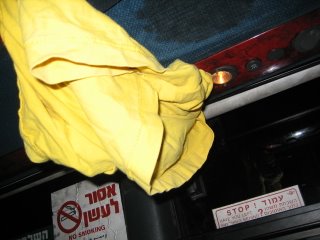

An hour later, Ian was awaken from his slumber by a panic on the bus. I turned around to see what was happeneing. There was smoke coming out of the back of the bus and people were unloading from the front of the bus, and taking all of their things with them. It was a little weird that the bus driver did not open the back door, but I guess that if it were really an emergency he would've. It turns out the bus was overheating.

We walked away from the bus as two more stopped on the side of the highway to pick us up. We were about 20 minutes outside of Jerusalem on Highway 1, so there were a lot of buses driving by.

I can't help but think that my t-shirt jamming the vent might've contributed to the bus overheating. Hopefully not.