Sunday, June 19, 2011

The city's largest furniture store

If you are in the market to furnish a home or apartment in Quito, you could go to one of the city's many lavish malls, which are full of brand-name stores helping you outfit your house at brand-name prices.

But if you are interested in doing that at a fraction of the cost, you should go to the 24 de Mayo Market — up the hill from the city's colonial center. If you don't have an arm or a leg to spare, this place is for you.

It might lack the mall scent that invites you to continue perusing until you find the item you are looking for. The 24 de Mayo market smells more like urine - an odor that really makes you think "I'm paying way too much for this."

But that is the price you pay for not paying too much.


Working your way through the market is a game of cat and mouse.

You walk up to one of the stores. The woman asks you what you are interested in, and you tell her. Then she gives you a price.

You mull it over, scratch your beard for a few seconds, and let the silence linger in the air. Then you respond with a counter offer, which the woman promptly rejects being way too low.

So you begin to walk away. At this point, the woman will give a counter offer that isn't what you are willing to pay but is headed in the right direction. So you stick around. At this point, you could repeat your original counter offer if you believe it to be a fair price or you could begin to compromise.

The back and forth continues until you decide upon a price, unless of course you are interested in buying a few items. In this case you leave the original bargain hanging at a price that you are pretty comfortable paying and mention that you might be in the market for another item.

The dance begins again and continues until you are satisfied.


Bargaining is not something that comes naturally to Ecuadorians - or at least that I have witnessed.

I'm not exactly sure why.

Maybe there is a whole social status attached to buying products, the sense that if you don't pay a lot for something then it's not very good. My roommate thinks that they lack the business savvy that says you won't pay more for something than you have to.

This reminds me of one of my favorite stories I have heard from my Peace Corps friends: The Story of the $76 Papaya.

There was a fair at my friend's site and a competition to see which farmer could grow the biggest papaya. Someone from my friend's community won with a gorgeous, organic papaya that weighed 14 pounds (Apparently, that is not a great weight for a championship papaya, but some of the heavy hitters didn't enter the competition for whatever reason.).

So the guy wins the competition and takes home the $75 prize. Then his wife turns around and sells the papaya for $1, which was well below the going market rate for a papaya of that size.

Either way, the lack of business savvy was something that initially surprised me when I got to Ecuador, but I have gotten used to it.


If you are interested in negotiating at the 24 de Mayo Market, a little practice in the art of negotiation can take you a long way.


We pretty much outfitted our entire apartment at this market (beds, mattresses, tables, chairs, couches, etc) and saved several hundred dollars in the process.


The first time we purchased stuff for the apartment at this market, we bought three beds, three mattresses, three small tables, a dinner table, five chairs, and two benches.

One would think that transporting these items from the market to our apartment on the other side of town might be difficult. But the pick-up truck drivers near the market are experts in packing things into and onto the bed of the truck.

With one long piece of rope, he was able to fit all of those purchases into the truck. When it looked like his architectural masterpiece might be a bit unstable, we asked him if he wanted to put something in the cab of the truck for transport. He says, "no, there is always space."

We made it back to the apartment with four people in the cab and all that stuff in the bed.

So when someone suggests that there isn't space to hole anything else, you just tell them that there is always more space.

Thursday, June 16, 2011

A Water Museum?

This weekend, I visited Quito's Yaku Water Museum with my roommate and her sister.


Why would Quito, of all places, have a water museum?

More than 75 percent of the Earth is covered in water. Ninety-seven percent of that water is saltwater. Two percent of the water is locked up in ice caps. That means that one percent of all water on Earth is usable by humans. A miniscule amount of that one percent is found in the area around Quito.

So what's the deal with the water museum?

In the next few years, the Andes could be the site of a water crisis. Quito relies on the surrounding snow-capped volcanoes for water. But as these snow-capped volcanoes become less and less snow-capped as a result of climate change, there could be severe water shortages.

Quito decided that it needed to protect and conserve its watershed. Part of this process was an education campaign that explained the water cycle, the importance of conserving water, and how to do so.

This is where the museum comes in. Located on a western slope of the valley overlooking the Old Town, the city built the interactive Yaku Water Museum the educates residents about water. It's not a typical tourist destination.

The museum receives student groups during the week and is open to the general public on weekends (by the way: the last Saturday of every month is free). The museum is geared toward children.

It starts by explaining the process by which water arrives at our homes: starting on the mountains and streams before being collected in reservoirs and undergoing a purification at the water treatment facility before delivery to individual users.


As I mentioned before, it is a very interactive museum. The exhibit talked about the ways in which we use water. Here I am showing the rest of the tour group the proper way to wash clothes on a rock.


Then, visitors talk with the interactive guides about how they can conserve water.

The second half of the museum tour is full of experiments that the kids can do to learn about the various properties of water. There is even a room where you can play with bubbles.

After completing the tour, visitors can enjoy the views overlooking the valley Quito is in.

Tuesday, June 14, 2011

More than grocery shopping

Sunday morning, I was walking from my apartment to the local market to buy my produce for the week. I had gone for a long run earlier in the morning and hadn't showered or changed my clothes yet. I went to the market in a soccer jersey, running shorts, and sandals. My roommate also went to the market in her running clothes.

On the way to the market, we bumped into a friend.

Friend: Where are you going?
Ian: To the market.
Friend: Dressed like that? You look like you should be exercising, not going to the market.


Apparently, you don't just go to the market in Quito wearing whatever clothes you have on. This is because you aren't just going to the market to buy groceries. You are going to the market to be seen.

And if someone saw you in running shorts and soccer jersey at the market, that will not bode well for your reputation.

Luckily, I'm not that interested in people in town thinking "Man, that guy has really nice clothes. He must also have a lot of money that we want to rob." I'd rather people be thinking "Man, that guy's soccer jersey only cost him $3 and those shorts only cost him $2. I'll just let him do his shopping in peace."

Sunday, June 12, 2011

Life in the city

I returned to Ecuador about two weeks ago after spending a month and a half at home. I had a great time at home, celebrating holidays and special occasions with my family and spending time with friends. As nice as it was to be home for such a long time, I was ready to get back to work.

I have been adjusting to my new job in Ecuador.

To give you a brief update of my timeline: In February, I left my site in the south of the country to assist in training the new group of volunteers. I lived about a forty minutes outside of Quito at the Peace Corps Training Center. In the middle of April, I started my vacation and returned at the end of May.

I am now living in the capital city of Quito, working as a Peace Corps Volunteer Leader out of the PC Office. I live with two other PCVLs in the north side of Quito. I will be here until next May. Then, who knows?

In the meantime, I will be providing support to the volunteers in the field and helping out in the office. I will also be spending part of my time working with an NGO (I will tell you more about this when I know more about this).

I look forward to the opportunities this gig will provide. Not only is there potential for professional development, but there will also be plenty of blog content. The combination of adventures in the big city, life with my roommates, the possibility of getting out in the field, and the unexpected ridiculousness of Ecuadorian society will make this a great year for the blog.

Friday, May 06, 2011

Behind the wheel


Hey, donkey. Off the road!

In Ecuador, you hit the animals with a stick to get them out of your way. When you are driving 45 mph down Orchard Lake Rd., you just hope there aren't any livestock in the way. I guess I could try the horn.

Thursday, May 05, 2011

You think that's bitter...


If you have only dealt with store-bought horseradish, you don't understand the bitterness of slavery.

My family has traditionally purchased jarred horseradish for our seder plate. This year, we decided to change it up a bit. We decided to grind the horseradish ourselves. (Actually, at one point we thought of using our own horseradish root, but the root disappeared in the garden over the winter.)

You might be familiar with the sinus-clearing sensation that fills your nasal passages upon consuming a Hillel sandwich. When you grind your own horseradish, the entire room smells of horseradish.

That is why ski or swim goggles are recommended, but the only ways to ensure full protection would be a Hazmat suit or purchasing a jar from the market.

Wednesday, May 04, 2011

The home office?


Are these billable hours?

Tuesday, May 03, 2011

Se llame nieve

I arrived back in Michigan on April 15th — nearly a month after winter officially ended.

It snowed on April 17th.


I am about to throw this snowball at my younger brother.

Most people were unhappy about this late-season snow. I, on the other hand, was pleasantly surprised with this turn of events. I hadn't seen snow since February 2009. (Although there are glacier-topped volcanoes in Ecuador, it does not really snow below the summit. So very few Ecuadorians have ever seen snow.)

Monday, May 02, 2011

Guest blog: Mom's first dispatch

So they tell me the smile is very apparent, I didn’t have to go bring home the herd like Billy Crystal in “City Slickers.” All I had to do was have Ian return home for a visit after 27 months in Ecuador.

I am pretty happy to sit in the adjoining office (AKA the other sofa) and watch TV shows and movies with him. So far we have watched the first season of “Friday Night Lights.” Ian has caught up on “The Office,” “The Simpsons,” “Parks and Recreation,” and “South Park.” He has also been introduced to “Glee,” “Modern Family,” and “Breaking In.” Maybe he will blog about these new TV shows he has seen.

Since Ian has been home, I have able to treat him to fruit that is not readily or monetarily available to him in the Peace Corps. He has been happy replacing his beloved mango with raspberries, blueberries, strawberries, and the occasional container of pomegranate seeds.

Another special time we are sharing is going to the grocery store and sometimes even to a Costco or Sam’s Club. These are a little overwhelming for him, both in price and selection. He purchased a set of measuring cups, a pizza cutter at the Salvation Army store in Ann Arbor for his new apartment.

I am looking forward to going to garden stores with Ian and also for Ian to get to work in my garden. This will involve getting out of the office. Stay tuned.

Sunday, May 01, 2011

Ya mismo is now

I am currently visiting the United States on home leave. I have been here for two weeks already and will be here for another month before heading back to Ecuador to complete the third year of my Peace Corps service.

As I have been sharing some of my experiences from South America on this blog, I figured that you, the loyal blog reader, might be interested in reading about how I have been adjusting to life in the States.

If you were looking for signs of how I have changed over my two years in the Peace Corps, pre-Peace Corps Ian probably wouldn't have delayed two weeks before uploading my first dispatch.

In Ecuador, there is a saying "ya mismo." I have been using it to explain when I will start blogging again.

The conversation would go something like this:

Blog reader: Ian, when are you going to blog again?
Ian: Ya mismo.
Blog reader: I don't speak Spanish. What does that mean?


There is no good translation directly to English. The best way to explain it would be to say that it will probably happen eventually, maybe. It might be in ten minutes. It might be ten days. It might be ten months. But at some point in the history of time, it should come to pass.

Well, for you, blog reader, ya mismo has arrived.


Much like how this blog has not covered everything I have done in Ecuador, the home-leave blog won't be exhaustive. What you will get out of these blogs are some highlights from my visit home and cultural differences that I encounter in my time back home.


In Ecuador, drinking tap water isn't recommended — unless, of course, you are willing to spend the next 24 hours on the toilet.

In the United States, you can drink the tap water. And not only that, but when you go to a restaurant, you can get as much iced tap water as you would like and not have to worry about potential digestive issues. (And it's free.)

My travels back to the United States included a five-hour layover at the Miami airport. What does someone do for five hours in the Miami airport?

Drink large quantities of tap water.

I kept refilling my plastic cup with ice and water from the drinking fountain until it was time for my flight.


Have you noticed that there aren't that many pay phones in the United States any more?

You probably wouldn't think about this because you probably have a phone in your pocket/purse.

I never really thought about this either, but when I arrived in the Miami airport and wanted to tell my parents that my first plane had arrived, I had no way of contacting them. With no pay phones, I had to find other solutions.

So I went up to some nice-looking people who were waiting at my gate and asked them if I could borrow their phone for a second. (A perfect no seas malita moment)

They were glad to help. And my mom really appreciated it.


I walked out of baggage claim at Detroit Metro airport, and my family was just pulling up. I didn't jump into the car like one jumps onto or off of a moving bus in Ecuador, mostly because everybody wanted to hug me.

We started driving home from the airport, and the first thing I noticed was how smooth the road was. People always joke about how bad the roads are in Michigan. But after spending more than two years in Ecuador, I couldn't help but notice how nice of a ride it was.

Something else that really caught my attention was how traffic flowed. Driving down Telegraph Rd. from the airport toward home, we barely stopped at any of the traffic lights. This is probably because Quito, where I have been living the last two months, has a reputation for horrible traffic. Also, we cruised at 47 MPH, which is the secret to smooth-sailing on Telegraph.


We are working on trying to get my mom to contribute some guest blogs about what it's like to have me home. If you know her e-mail address, tell her that you'd appreciate this.

Sunday, April 24, 2011

Speech notes

Yesterday morning, I gave a speech at my synagogue in West Bloomfield about my two years of service in Peace Corps Ecuador. For those of you who could not make it or would like to relive the experience, I have pasted the notes I used during the speech below.

I hope to continue to update my blog about my visit back home. I have been home for a week and have plenty of blog-worthy material to post. The issue has been finding time (I guess I could have eliminated this afternoon's siesta to blog a bit, but it was very necessary.)


Depending on weather: "It's a good thing that rain stopped. Because if this were Ecuador, people don't leave there house during the rain. No one would have showed. No minyan."

Shabbat shalom con todos y todas presente, Les agredezco por la oportunidd de compartir mis experiencias con ustedes.

So you think this would work better in English? Luckily I also printed up an English edition as back up.

Thank rabbi for giving me the opportunity to address the congregation this morning. It feels good to be back home, even though it might be a different house.

This week we have been talking about the Jewish people's 40-year journey from slavery to freedom. It was an epic journey with its ups and downs, with its wonders and difficulties. But at the end of the trek through the desert, we emerged as a different nation, one ready to face the challenges associated with independence. And these experiences built the character traits that continue to maintain us as a people.

We are all on journeys - as individuals, as a community, as a nation.

I would like to talk to you this morning a bit about the journey I have been on the last two and half years in Peace Corps Ecuador.

When I joined the Peace Corps in February 2009, I knew that it would be an experience unlike anything I had ever done. It seemed like an incredible opportunity to give back and put in practice the ideals of tikun olam
Opportunity for personal growth, greater perspective, learn another language

For those of you who might be very familiar with Peace Corps...
Agency started by John F. Kennedy in 1961 to promote world peace, sending Americans to countries in the developing world to provide technical and engage in a cultural exchange. It currently operates in 77 countries.

Natural resource conservation volunteer placed in a small coastal city of 17,000 in southern Ecuador, very close to the border with Peru
It is an agricultural town, whose primary crop is banana
The area is known as the world banana capital
Celebrate the fruit every year with the world banana festival
I worked with the local municipality in the office of environmental management
Tree nursery, gardening, environmental education, community bank, and recycling program. I also worked extensively with youth groups.

I have just now finished my two years and decided to extend my stay for another year and serve as Volunteer Leader. Instead of living in a small town, I will be based in the capital, Quito, working out of the Peace Corps office there.

As a Peace Corps volunteer, one is not there to impose solutions to the community's problems. Instead, one is supposed to work together with community members to identify those solutions.

If the process isn't participatory and the community doesn't take ownership over the project, it will not be sustainable. I saw countless examples of this in Ecuador, where people go in with great intentions but don't go about it the right way, and the initiative stalls out.

The idea is that volunteers empower the community to begin address some of its problems.

One initiative that I worked on is a community bank project, based on microfinance models made popular by Mohamed Yunus or C.K.Prahalad
• My counterpart agency was installing a running water project in an isolated community, about an hour and half from my house
• I had to take two buses and walk thirty-minute walk across three rivers to get there. The bus only ran twice a day. And in the rainy season, you could barely get there.
• It is a village of two families but thirty households

One day during a meeting of the water council, I talked to the members about what they thought were some needs of the community. As a small community, it was difficult for them to ask for a lot of resources from the government. So any initiative they wanted to undertake had to come from their limited resources.

They mentioned that a nearby community had started a kind of community bank, and the idea really interested them. I explained to them how the bank works. We started with two informational meetings to explain how it functions. The third week we elected the administrative committee that would be in charge of running meetings. The members write the constitution that will govern their bank. Because it is their institution, they have to decide up the by-laws

People are concerned for the security of their belongings in Ecuador, even in a village with two families. The community bank box has three different sets of keys and locks. The box itself is kept in the house of a fourth person so members can trust the safety of their deposits.

At the fourth meeting the members made their first deposits to the bank. After four weeks of deposits, they can start loaning out the money. These microloans, worth no more than $100 dollars have to be paid back within a month plus a small interest rate of 5% to 10%. The principal and the interest get returned to the box to be loaned out to the other members.

At the end of the bank's fiscal year, they divide up the contents of the box among the membership. That way the members would enjoy the benefits of savings in addition to the access to credit that they received throughout the year.

The bank is now on its third year and has 70 members.

While starting this bank was a beneficial experience for the community, I also found it quite rewarding and humorous.

Because of the bus schedule, I was forced to spend the night there every time I went for a meeting. One week I brought a frisbee to play with kids. Most people don't know what a frisbee is. They really enjoyed playing with the disc, but not in the traditional sense of "playing frisbee." One of the three-year olds in the village took his machete (yes, three year olds have their own machetes) and chopped a few holes in the frisbee, making it much less aerodynamic.

One week a self-proclaimed archeologist randomly showed up in our office. No one really knew what he was doing in town, but he charmed everyone with his stories of hidden treasure and convinced my office that on the way to the community bank meeting one night, we should stop at some guy's house and search for gold. We drive up to this shack, the archaeologist pulls out two copper rods that he used like a Ouija. He asks the rods a question and, depending on the way the rods move, he decides where to search. They spent a few hours digging and didn't find an tangible gold, but I found plenty of comic gold.

On the rare occasion that the municipality would give me a ride up to the bank meeting, more often than not, the thirty-year old jalopy would stall out on the road and we'd have to call another car from town to come pick us up. One time the car stalled only if we turned on the headlights. So we used my headlamp and cell phone flashlight to guide us home.

In addition to the bank, I worked with my counterpart agency on solving some of my town's numerous waste management issues. Local governments in Ecuador want to have smooth-running waste management collection operations that separate between organics and inorganics and also separate out recyclable materials so that they don't have to put as much in the limited space available in landfills.

The problem is that changing this culture is a long process. In Ecuador, the first instinct when someone has a piece of garbage is to throw it on the ground or out the window of the bus. Once, it came back through my window and hit me in the face. The first instinct when they have a lot of garbage is to make a pile and light it on fire. My neighbors liked to add gasoline to their daily 6:00 a.m. garbage fire. I assume that was for a bigger flame.

Because the city budget was a mess and trying to allocate a lot of funds for a big-time waste-management project was impossible, I worked with my counterparts to identify small-scale solutions to the problem. They thought that we had the resources to implement a municipal recycling program. We would locate recycling bins throughout the city, and residents would deposit their recyclables there — instead of burning them or throwing them in a field outside of town. We created posters and pamphlets to promote the project and recorded ads for the local radio station.

The bins were supposed to have been installed last October. But there were some unforeseen delays.

For example, the bins were painted with a kind of paint that would rust in the rain, so we had to get them all repainted. But it took a month to find someone who would paint the bins. Then the municipality delayed its payment and thought its own people could paint the bins. They were wrong.

Then, the local fiestas happened. The municipality went back to its initial contractor but continued to delay its payment. Then Christmas happened. Then they finally freed up some money to pay the contract, and the bins were finally painted at the end of January. Except that those bins were only painted one color — no one put letters indicating what could be deposited in which bins.

Last month, they finally put the bins around town. The radio ads have hit the airwaves. They were supposed to start the street-level promotional activity tomorrow, but then realized it was Easter Sunday and will probably start that work next week.

While all of these delays were happening, I was working with local schools, teaching students and teachers about the benefits of recycling. Working with my counterpart and another Peace Corps Volunteer, we developed a curriculum for teaching students about recycling. We hosted a recycling contest in two local schools, which my parents helped with when they visited, and gave a workshop to teachers and school staff about how the recycling program functions so that they can teach the students how it works. We had also planned to give similar instructional sessions to local government workers and student governments at the high schools.

I also worked extensively with local youth. I helped them start a community magazine. Working with thirty high school students and another Peace Corps Volunteer, we produced a magazine that talked about some of the positive community projects happening in Arenillas. The youth made seven editions in the first year and are now starting a television show.

At first, many were skeptical about whether or not the high schoolers could pull it off. It was that doubt that motivated our students. One of our journalist's dads told her, before we made the first edition, "Are you kidding me? Kids can't start newspapers."
They proved him wrong.

In addition to the technical exchange, Peace Corps emphasizes the cultural exchange between volunteers and Ecuadorians. Ecuador is more than 90% Catholic. Most Ecuadorians have never met a Jew before.

When I first moved there and was living with a host family, my host dad's first response when I told him I was Jewish was "oh, yeah. Like the raid on Entebbe? Very cool."

One of my favorite ways to share Jewish culture is through food. Every Friday night I would cook shabbat dinner for my friends and coworkers. It is my favorite time of the week in the States, and I wanted it to be that way in Ecuador, too. I would make challah, kugel, knishes, babka, matzah ball soup, pita, hummus, tabouli, mandel brodt, and shakshuka. (sorry to be talking about this stuff in the heart of Passover),

My friends liked the food so much they came back every week. Some of them even asked for the recipes. One day I went to my friend's house and her three-year old son was eating dinner. He had on his plate rice, chicken, and something else. I asked him, "Pierrro, what are you eating?" (but in Spanish, of course)

"Se llama kugel" (It's called kugel)

Not all experiences with Jewish cultural foods worked out so well. During shavuot my first year I baked a cheesecake to share with my coworkers. I offered it to a number of my friends to try, and they enjoyed it. The garbagemen, though, spit it out in my face. Cheesecake must be an acquired taste

While being a sole practitioner has is downsides, there some aspects that aren't that bad.

For example, my yom kippur services were about nine hours shorter than usual. Feel free to join me next year, but only up to eight people are allowed. If that happens, we'd probably have to start another non-minyan.

Last Passover, I had a very special guest. Adam Baruch was travelling through South America and visited me. He ate shabbat dinner at my house, helped me clean jametz, and we went to seders with the Jewish community in Quito - a 12-hour bus ride from my site.

The Quito Jewish community has 400 members, three rabbis, two synagogues, and two shokhets that don't recognize each other's hashkakhah. With my job being based in Quito next year, I look forward to become more active in - if only for kiddush luncheon.

Now I don't want to hold you up much longer before your kiddush luncheon - or today's modified kiddush. If you have any questions, you can find me by the dried fruit.

Shabbat shalom and jag sameaj - two j's. Think about it.

Thursday, January 20, 2011

You failed, and the whole town knows it


D+!!!!! Oh my God .... I passed! I passed!!!!! Oh, man!! I got a D+! I'm gonna graduate!!!!

(Hug random Asian kid)

I wish we'd known each other. This is a little awkward.


Similar scenes to this one from the beginning of Tommy Boy happened all over the Ecuadorian coast this week*.

*Except instead of hugging a random Asian kid they might have hugged a random squinty-eyed Ecuadorian whose nickname will forever be Chino.

Schools in the coast run on a different calendar than those in the sierra and oriente. The highlands and jungle school year is very similar to the United States (September through June), while the coastal school year run from April through January. I believe that the different schedules exist to offset for climate* and the harvest schedule**.

* Not even the teachers would show up for work in the rain.
** Youth had to help their families on the farm.

Whereas Marquette University put a list of all the students and their grades on the wall, schools here only posted a list of students who failed and will be held back a year. There is no number system to hide a student's identity. The school puts up the kids full name. If you failed, everyone knows about it.

If a student fails one subject, he or she has to repeat the entire academic year in the same grade. It doesn't matter if a student does well in every other subject, he or she will have to repeat the entire year.

Students are given the opportunity to retake an exam if they fail it the first time around.


As you know, I will take any opportunity to cite Tommy Boy that I can. I was really looking for a way to put "D+ isn't a grade they like to give out, I'll tell you that much" into the post but was only able to find space for it here, at the end, below the divider line.

Tuesday, January 18, 2011

And that's how you build a fence...

Last time we left off with my cactus fence, I had been attacked by some hornets, and the fence was non-existent.

Well, we have since decided to switch directions, in terms of cactus.

The previous species of cactus that we had used for the fence grew straight up. We are now using a kind of cactus that grows out horizontally. This should be much more effective as a fence.


As you can see from the picture, no sane or sober person would think of crossing that fence of cactus. Luckily, this species of cactus is just as easy to propagate as the other one. All you have to do is stick a piece of the cactus in the ground and, voila, you got yourself another cactus plant.


The owner of this fence was nice enough to let us use the cacti he had pruned off of his fence as starter seed for our own. So Saturday morning we rented a pick-up truck and filled the bed with cactus.


Then we planted the cactus along the border of the forest we are hoping to protect.


The cactus should grow at a rate of about one meter per year, according to the other fence's owner's niece. So as long as the youth from the local high school take care of the cactus plants and don't decide to light them on fire (like some youth already decided to do) we should be describing the botanical gardens as some sort of impenetrable fortress in a few years.

Thursday, January 13, 2011

PERUsing

I have returned from an adventure in the land of Peruvian flute bands.

Disappointingly, and ironically, I didn't see any of those musical groups.

But despite its lack of flute bands on every corner, I greatly enjoyed my ten-day journey from Lima back to Arenillas. (For a more detailed account of my travels, continue reading below the slideshow)


The following map illustrates my itinerary from Lima back to Arenillas (keep in mind that the my house is not drawn to scale).


(This was not my first time traveling in Peru. In between my senior years of college, I backpacked from Quito to Rio de Janeiro. During that trip, I spent nearly a month in Peru and had the opportunity to see some of the more traditional tourist destinations.)

Lima

This was my second time in Lima. I was using Lima as more of a launching pad in this trip than anything else. Lima doesn't offer too much in terms of tourism, and I had covered the main sights in my first visit. I arrived in time for New Year's Eve and was able to bring in the new year with fellow travelers at our hostel in the Miraflores neighborhood of Lima.

We ventured out to a seaside park and shopping center (with plenty of bars and night life). At 2:00 a.m., the place was still full of people of all ages bringing in the new year. There were families with little children, senior citizens, and young people. It was pretty fascinating to see.

The next day, it felt like the entire city was recovering from a hangover (because it was). The streets were dead until noon. I had to change some money to buy a bus ticket for the following day and had a lot of trouble finding a money changer at 11:00 a.m. in a city that is normally teaming with people who will readily change dollars to soles.

I spent the afternoon watching college football at a sports bar. After the game, I randomly bumped into a fellow Peace Corps volunteer from Ecuador, who I had no idea was going to be in Lima. She was heading off to Cuzco and Machu Picchu the next day, so we went out for dinner that night.

On Sunday January 2nd, I played the role of tour guide, leading a group of Swedish students on a little stroll through downtown Lima (Bite-sized Three Musketeers included). Lima is such an old city and has so many different building styles because fires and earthquakes have leveled portions of the cities in different eras. So it is not unusual to see old buildings from different generations next to each other.

Chiclayo

That night, I headed northward along the coast to the city of Chiclayo. The area is rich in archaeological ruins and museums. It is also reputed to have one of the largest street markets in all of Latin America (The market even has a witchcraft section).

I was interested in visiting the dry tropical forest reserve of Bosque de Pomac because the ecological reserve near my site is dry tropical forest. I wanted to see how they have developed the tourism at this reserve to get some idea on how it might happen in Arenillas. I learned that the big attracting in the reserve are some pre-Incan pyramids that were used as burial sites for the kings. (They have yet to discover such important archaeological ruins in the reserve in Arenillas, so I guess the tourism will just have to wait.) I thought the forest was really interesting. There were some trees in the forest that were more than 500 years old.

In the afternoon, I wandered through the giant street market. I love street markets. I especially enjoy hunting for one specific product in a maze of tents selling anything you can imagine. Luckily, I arrived at the Chiclayo street market with a certain product in mind.

When I was backpacking through South America on my previous trip to Peru, I had purchased a soccer jersey for the club from Cuzco. I had seen the club play in person during an alternative spring break trip to Buenos Aires. Unfortunately, I had lost my jersey on the beach in Rio de Janeiro.

So I set about finding a replacement jersey at the market in Chiclayo. It didn't take nearly as long as many of my other ventures through street markets (e.g. sesame seeds, nutmeg, white carrot, Wrestlemania III), but it was exciting, nonetheless.

Chachapoyas

In 2007, Chachapoyas was barely on the tourism map. The only way to access the principal attraction — The Kuelap Fortress — was to trek for several days across the valleys to reach it. For someone with plenty of time on his or her hands, that was a great adventure. But it was also the only attraction in the area.

Now, the area boasts one of the world's tallest waterfalls. I know what you are thinking. How does that happen? Can a waterfall just appear overnight? I'm not an expert in waterfall creation, so I couldn't tell you the answer.

In 2006, a German guy measured the height of Gocta Falls at 773 meters, which makes it the third highest waterfall in the world. Apparently, the locals had known about the falls all along, but they thought it was haunted, so they didn't bother to tell anyone about it.

Now you can take day trips to the Kuelap fortress and the Gocta Falls, which is exactly what I did. I spent another day hiking to a nearby artisan village.

Mancora

The north coast of Peru has a reputation for being a top surf destination. Apparently it boasts one of the world's longest left-hand breaks. As a non-surfer, I don't really appreciate that fact, but you might. One result of these waves is that surfing and beach towns dot the coastal highway. The biggest of them is Mancora.

I'm not much of a beach guy myself. I prefer to be moving around. But I had a couple of days before my vacation ended, and Mancora is on the road back to Ecuador. So I figured I would stop there. The town has a big party scene. Luckily, I was staying at a hostel on the outskirts of town and met some similarly laid-back, not-so-into-the-party-scene backpackers. So I passed a couple of lazy days in Mancora before taking the bus back to Arenillas.

It took about four hours to travel from Mancora to Arenillas, and I was really excited to make the trip because I like the idea of traveling with a final destination in mind (as opposed to looping back to where I started from). Plus, I often go to the border town of Huaquillas, which 20 minutes from my house, to get t-shirts made or to buy soccer jerseys (there will be an upcoming post about all the jerseys I have bought) but I had never gone through the full border crossing. All of the travel books say that it is a horrible border crossing. I went through it without any problems and got back to my house safe and sound.

(In total, I was on vacation for nearly three weeks. I spent the first week and a half in Panama with my family. We saw some impressive sites and did had some great adventures. But more than anything it was really special to be able to share the experience with everybody. I hope to put some photos up from that part of the trip, but I have had some photo-sharing difficulties.)

Monday, December 20, 2010

Es la estación


I guess " ´tis the season" sounds better in English than Spanish.

My neighbors just finished their third consecutive night of caroling, each night is progressively more rocking than the previous.

Tonight's most popular song was "Navidad." The lyrics, to the tune of Jingle Bells, are as follows "Navidad. Navidad. Navidad. Navidad."

Catchy, eh.


This afternoon we had the office gift exchange. On Dec. 1, we held an office-wide meeting to set the parameters for the exchance.

It would take place on Monday, Dec. 20 at noon. Everyone was informed. We all drew names out of a hat. Price limit was $5.

I drew our office's secretary. I had had several conversations with her about how she wanted to read more books, except that she didn't have any. I went to a book store last week and bought Charlie and the Chocoloate Facotry, Old Man and the Sea, and The Alchemist.

I showed up at the office today at 12:15 ready for the exchange, knowing that it wouldn't start on time.

Ian: What time are we going to do the exchange?
Co-worker: Noon.
Ian: It's already 12:15.
Co-worker: I know. We all have to go buy our presents first.


They all proceed to leave the office and go to the gift store down the street for presents before meeting back at a restaurant for an office Christmas party.


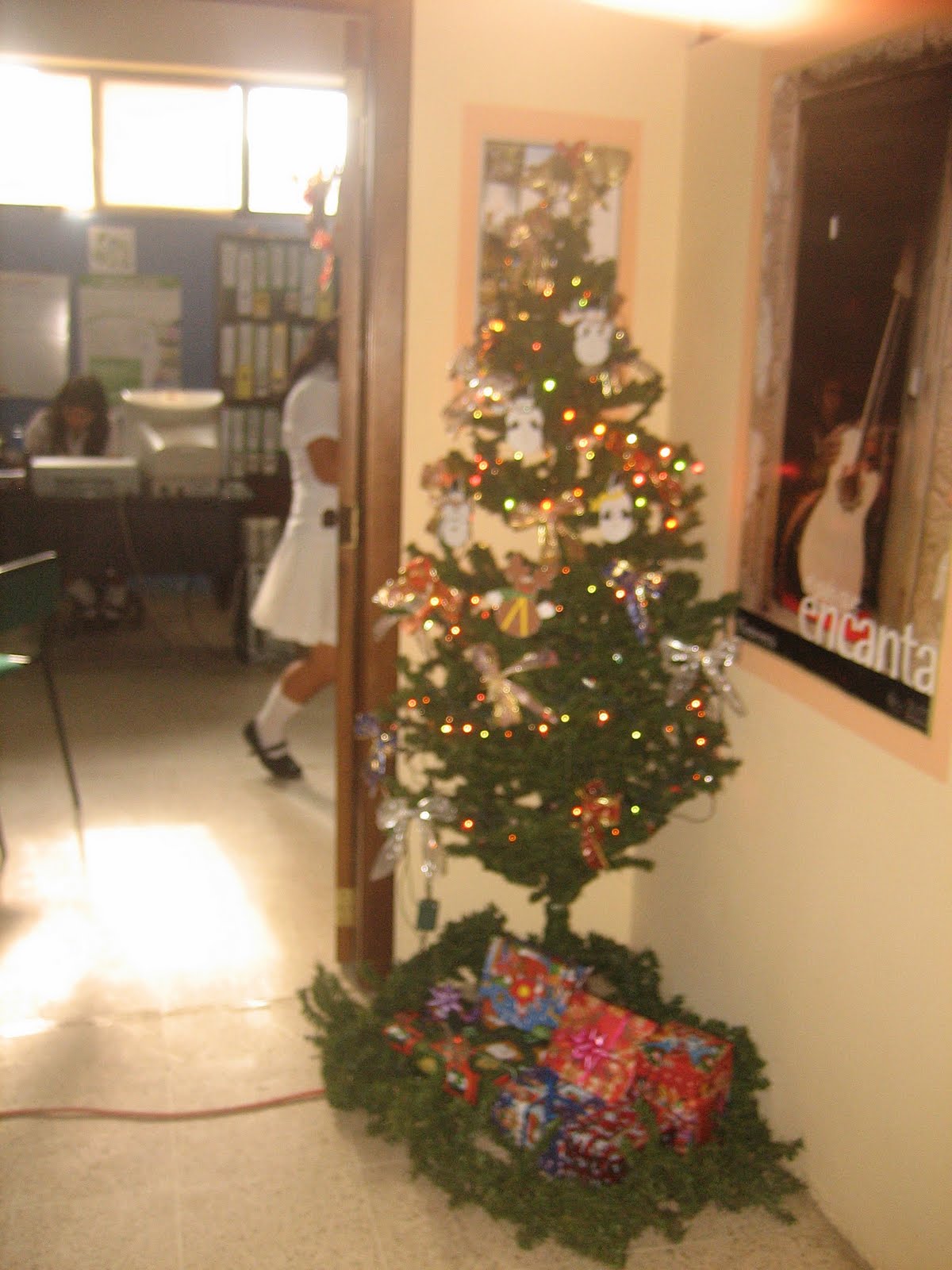
The Christmas decorations that you see at the top of this post were made by my co-workers. They spent an entire week decorating the office for Christmas.

Saturday, December 18, 2010

Dating

According to a horribly unscientific Google search, there are five streets in the United States named after the 4th of July.

On the other extreme, every city in Ecuador with labeled streets has several streets that mark watershed dates in their heritage.

In Arenillas alone, there are at least two main streets and four neighborhoods commemorating important days in the calendar year (Streets: May 24, November 11; Neighborhoods: October 9, December 25, May 24, and November 11).

November 11 celebrates the anniversary of the county's independence. May 24 is the anniversary of the Battle of Pichincha. October 9 marks Guayaquil's independence. December 25 is Christmas.

This is common throughout the country and Latin America, and definitely something that we missed out on in the U.S. (I know that in Israel there is November רחוב כט, but I don't recall that every city has streets named after famous dates)

Every city in Michigan, for example, could have January 26 St. to remember that on January 26, 1837, Michigan achieved its statehood. A main thoroughfare in Detroit would be named July 24 because the city was founded on July 24, 1701.

It would be a great way for people to remember a bit of local history, as well. I guarantee that every person in Arenillas could tell you that Arenillas was founded on November 11, 1955. Do you know on which date your city was founded?

But this trend of naming things after important dates extends beyond streets and neighborhoods. One of my volunteer friends adopted a cat a few days ago and named it 14 de Diciembre (December 14).

I haven't seen this trend expand into the naming of children yet, but how could you forget someone's birthday if it was his or her first name?

Friday, December 17, 2010

Apocalypse now?

A guy got on the CIFA bus last week and claimed that the apocalypse was upon us.

I understand that this is completely normal on public transportation all over the world, but this was the first time I came across "end of the world is upon us" guy on the CIFA.

As soon as the bus pulled out of my town heading toward Machala, he told the bus driver to cue some doomsday music on the bus stereo system. This was the first time I had seen someone hijack a bus speaker system for his shpiel.

With the mood set by a bouncy bus ride, Armageddon music, and the stench of urine, he began throwing out some quotes from the bible describing what will happen at the end of days.

He described chaos and torrential rains at the beginning of the end. He asked everybody on the bus if they have noticed that it was raining harder lately. Because we are experiencing the first hard rains of the winter season, everyone agreed that it was starting to rain.

Then the speaker said that from this destruction will come unity. He described how Belgium signed a peace treaty and merged with three countries in 1998. (I did some research on Belgian history. Either this guy is wrong or the Internet is wrong.)

Unfortunately, I had to get off the bus at this point and couldn't stay for the end of his talk and how, if you donated to him, one could mitigate the effects of the end of the world. I really to stay on to see how it would end, but I would have missed my stop and been forced to backtrack through some shady areas.

Thursday, December 16, 2010

Bus vendors

"Ladies and gentlemen, I apologize for interrupting your ride. I give you all the respect that you deserve..."

And so starts every bus shpiel in Ecuador.

From there, there is no telling what direction the vendor will go.

• You have the guys carrying a briefcase selling the health benefits of noni, claiming that it will cure cancer, gastritis, kidney problems, and chronic liver issues.

• Other guys will claim that this is the only way for them to make an honest living. They have decided to offer you the opportunity to buy some candy - at 300 percent the listed price. Sometimes they play up the "otherwise I would rob this bus" angle, while others say this is how they pay for their education.

• A guy goes on about the importance of learning languages before giving everyone the chance to buy an English-Spanish dictionary.

• I like the guy who passes through the bus giving out a pack of four DVDs or CDs to each passenger, allowing them the chance to look over the discs and different tracks, before he goes back to make the sale or recollect the unwanted discs. When he is handing out the discs, he takes a few seconds with each passenger to make you think that he is choosing those four discs especially for you.


Then there are the performers.

• My favorite musician is an old "guitar player"/"singer
/"songwriter" who rides the CIFA between Arenillas and Huaquillas. Now, I call him a "guitar player" instead of a guitar player because his guitar only has one string. I call him a "singer" instead of a singer because he is more of a whiner or bellower, not too much rhythm in his voice. He is a "songwriter" because most of his lyrics are just repeating the name of the city we are heading to.

If he ever made it onto YouTube, he would be a legend.

• A clown comedy troupe sometimes rides the local bus, making crude jokes and screaming in a really high-pitched voice.

• A one-man band also frequents the bus line from Santa Rosa to Machala. He is not that bad.


The amazing thing is that every single one of these guys cleans up every time they board a bus. There is some cultural phenomenon here where people will buy anything that is offered to them.

(Cleaning up in the sense that they make a lot of sales. Nobody cleans the buses here. Many buses have signs that tell passengers to throw garbage out the windows.)

Sunday, December 12, 2010

Bananera: From plant to box

Have you ever wanted to know how bananas get from the farm to your breakfast table?


This will be the first part in what I hope will be a series of posts that will explain the process.

Saturday, December 11, 2010

Not recommended

If you are looking for an IV or a vaccine in Arenillas, you could call this number (but you probably shouldn't).